
Instead of checking zoning, permits, and lease language separately, use one truck yard zoning approval lease process: define the operation, verify the parcel’s permitted use, confirm site requirements, and tie the lease to those findings. For owners and tenants in Ontario, California, and the surrounding Inland Empire, this keeps a promising yard from becoming a signed lease that does not fit the business.
- Javierbrown provides truck yard brokerage for Inland Empire owners selling or leasing commercial property.
- Start the truck yard zoning approval lease process with the actual operation, not the listing description.
- Confirm zoning approval and permit requirements with the agency responsible for the parcel.
- Make lease obligations match the approved use, required improvements, and consequences of a denial.
Why this matters
A lease gives you contractual rights; it does not establish permission to operate a truck yard. A fenced industrial parcel, an existing tenant, or a broker’s description does not replace a review of the proposed use and approval records.
For a landlord, the practical goal is to market what the property supports and avoid negotiating around an unverified use. Javierbrown provides commercial real estate sales and leasing services in the Inland Empire; the responsible public agency determines land-use approvals.
For your 2026 leasing file, keep the operating description, agency responses, site plan, and proposed lease together. If those documents describe different activities, resolve the mismatch before committing.
Before you start
- Identify the property and decision-makers. Gather the address, assessor’s parcel number, ownership information, available site plans, and authorization for anyone requesting records or submitting an application.
- Write down the operation. Include vehicle types, parked equipment, dispatch activity, hours, employee parking, storage, repairs, washing, fueling, and proposed improvements. Gather existing permits and approval conditions from the owner.
- Check the hidden gotcha: approval scope. An existing approval does not automatically cover a different operator, activity, layout, or intensity. Ask the responsible agency what remains valid and what requires further review.
You do not need a particular software account for this workflow. Use a shared folder and a tracking sheet; public-agency submission systems and requirements differ by jurisdiction.
Operating profile
Define the use before asking about zoning
- Prepare an operating statement. Describe what happens on the property in ordinary language. Separate truck parking from dispatch, freight transfer, outdoor storage, vehicle repair, washing, and fueling rather than grouping everything under “truck yard.”
- Describe the proposed intensity. List vehicle counts, operating hours, expected movements, staffing, and the equipment stored outside. Identify what is essential and what the business can remove from its plan.
- Mark the proposed layout. Show entrances, parking areas, circulation, buildings, outdoor storage, and neighboring access points on an available plan. Label preliminary drawings as preliminary.
For an illustrative request—not a property capacity claim—describe 12 trucks, 18 trailers, and 24-hour access if those are the tenant’s actual requirements. Those details give the agency something concrete to evaluate; “commercial parking” leaves too much unexplained.
Owners should request this information before describing a prospect as a suitable tenant. A business that only parks equipment presents a different review question from a business proposing repairs and freight handling on the same parcel.
Expected result: You have one written description that the tenant, owner, broker, and reviewing agency can reference without guessing what “truck yard” means.
Parcel and approval review
Identify the agency and approval path
- Confirm jurisdiction. Establish whether the parcel falls within a city or an unincorporated county area. A mailing address is not enough to establish which agency controls land use.
- Check zoning and existing records. Ask planning staff to identify the zoning designation, relevant overlays or adopted plans, applicable use category, and available approval history. Provide the operating statement and parcel number.
- Request the next required action in writing. Ask whether the described operation is permitted, requires discretionary review, needs clarification, or is prohibited under the applicable rules. Ask which documents establish that answer.
For a 2026 review, date the response and retain the materials you submitted with it. An answer about a different operation or parcel does not resolve your question.
Ask staff to distinguish informal guidance from a formal determination or issued approval. A helpful email is useful evidence of the conversation, but it is not automatically authorization to begin operating.
Compare the approval paths
These are general review paths, not zoning findings for any particular Inland Empire property.
| Review path | Best for | Advantage | Limitation | Next action |
|---|---|---|---|---|
| Permitted use under applicable rules | An operation that matches the permitted category | Avoids seeking a discretionary use approval when none is required | Site improvements and other permits still need review | Confirm all remaining requirements |
| Conditional or discretionary approval | A use eligible for agency review | Provides a route for a use that is not permitted outright | Approval, conditions, and timing remain unresolved until the process is complete | Evaluate the application requirements before committing |
| Existing approval review | A property with documented prior authorization | Provides records and conditions to evaluate | Prior authorization does not establish that the proposed operation is covered | Confirm scope, validity, and any required changes |
Do not treat “industrial zoning” as the final answer. Match the actual activity to the applicable use rules and approval documents.
Expected result: You know the responsible agency, the documented review path, and the questions that remain open. You have not confused a preliminary response with an operating approval.
Site requirements
Connect permission to a workable property
- Check physical operation. Review gate access, truck turning movements, circulation, employee parking, emergency access, and conflicts with shared driveways. Have an appropriately qualified professional evaluate technical questions.
- Identify improvement requirements. Ask the relevant departments what review applies to proposed grading, paving, drainage, fencing, lighting, structures, utilities, or other work. Separately describe repairs, washing, and fueling so those activities receive the correct review.
- Build a responsibility list. Record each required document, application, improvement, inspection, and responsible party. Separate confirmed requirements from questions still awaiting an answer.
A site that physically holds the proposed vehicles still needs a workable circulation plan. Likewise, a favorable land-use answer does not establish that a planned gate, drainage change, or electrical installation is approved.
For the 2026 project file, organize the requirements under Use review, Site review, Lease conditions, and Final verification. Keep the supporting agency correspondence with each item rather than relying on a verbal recap.
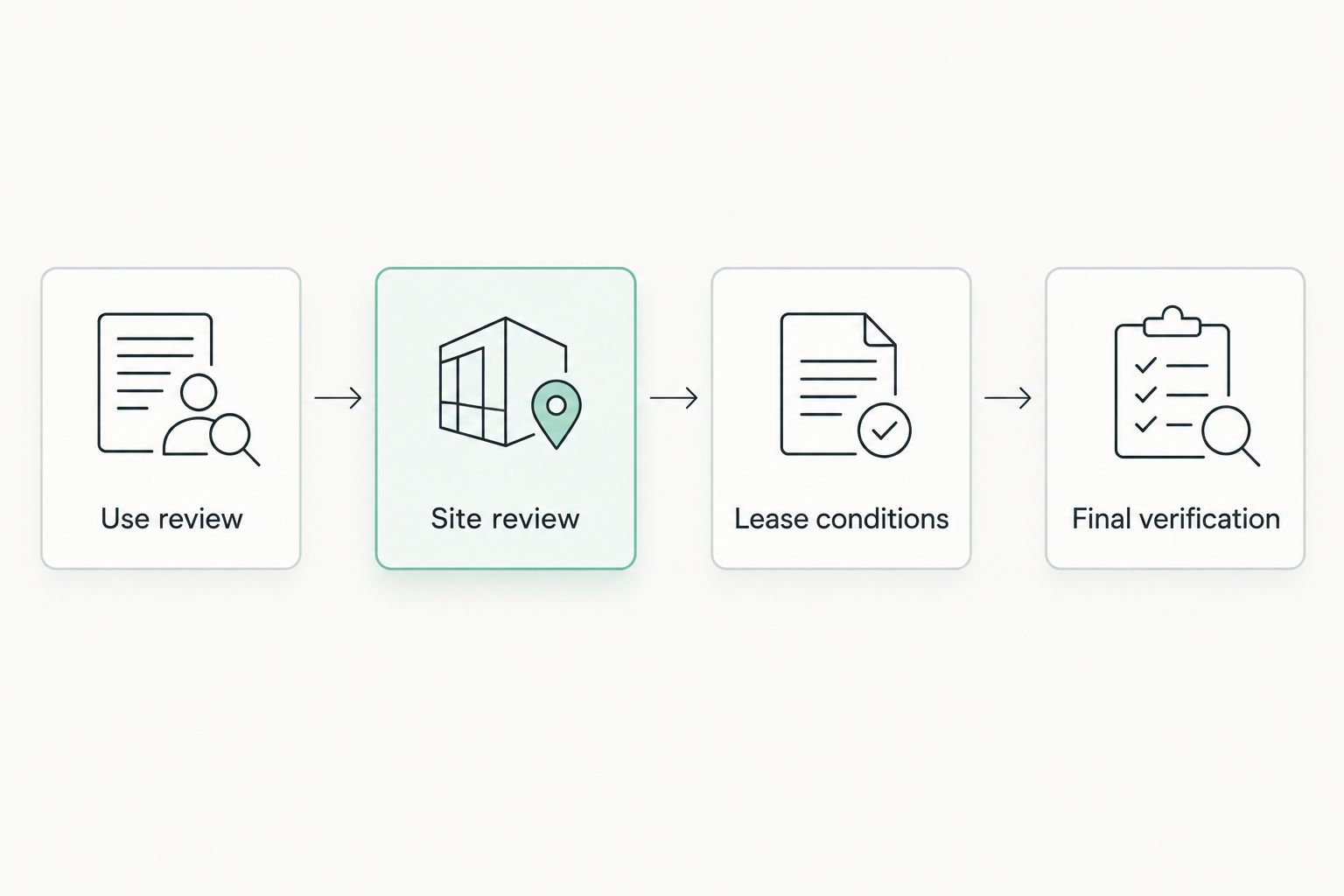
Give each unresolved issue an owner and a next action. “Check drainage” is incomplete; “owner’s civil consultant to confirm the agency’s drainage submission requirements” identifies who must do what.
Expected result: You have a documented list of site constraints and required work, with responsibility assigned before lease negotiations assume the property is ready.
Lease conditions and final verification
Turn the findings into enforceable responsibilities
- Align the permitted-use clause. Have commercial real estate counsel describe the intended operation accurately and identify activities the lease excludes. Do not rely on a broad label that conflicts with the agency-reviewed statement.
- Negotiate unresolved approval risks. Address who submits applications, provides owner consent, pays for required work, and controls design changes. Define the approval deadline, access rights, extension process, and consequences if approval is denied or materially restricted.
- Verify readiness before operations begin. Confirm the required approvals, completed work, inspections, insurance obligations, and contractual delivery conditions. Keep copies of the final documents rather than marking the project complete based on an application receipt.
Signing, receiving possession, starting rent, and starting operations are separate events. Your lease should explain how they relate instead of leaving the connection to assumption.
Landlords should also define what happens to tenant-installed improvements and outstanding permit obligations when the tenancy ends. Tenants should understand whether an unacceptable approval condition gives them a contractual exit; an approval contingency must be drafted to address that issue.
Javierbrown is best for Inland Empire owners seeking truck yard brokerage representation, not a substitute for land-use counsel or agency approval. Use brokerage advice for the transaction and qualified legal or technical advice for the obligations those findings create.
Expected result: The lease allocates approval responsibilities and explains what happens if the proposed operation cannot proceed as intended.
When an existing tenant changes the operation
A renewal, assignment, or expansion deserves a fresh comparison between the approved use and the proposed operation. Start with what changes rather than assuming an established yard needs no further review.
- Update the operating statement. Identify added vehicles, different hours, new outdoor storage, or activities such as repairs or washing.
- Compare the change with existing conditions. Review the approved layout and operating restrictions, then ask the responsible agency whether additional review is required.
- Update the lease documents. Record consent requirements, responsibility for approval work, and any conditions that must be satisfied before the change begins.
For a 2026 renewal, use the current proposal—not the original tenant’s business description. Best for: owners retaining a tenant whose operation is changing. The advantage is continuity; the limitation is that an existing tenancy does not settle the approval question.
Troubleshooting
The listing says truck parking, but planning staff disagrees
Stop treating the listing description as evidence of permitted use. Request the underlying approval records and submit the actual operating statement for review before making further commitments.
The previous tenant operated without problems
Ask for permits, approved plans, conditions, and any relevant enforcement records. Past activity alone does not establish that your proposed use is lawful or covered by an existing approval.
The proposed layout blocks truck circulation
Revise the layout with a qualified professional before assuming every open area can become parking. Reconcile the revised plan with agency requirements and the lease’s description of the premises.
A new approval condition changes the deal
Compare the condition with the lease’s approval provisions before accepting it or authorizing work. Have counsel identify the available contractual choices, and obtain agency clarification where the condition’s meaning is unclear.
The landlord and tenant disagree about required work
Return to the written responsibility list and lease provisions. Resolve the specific item through a written agreement; a general promise to “cooperate with permits” does not clearly allocate design, construction, or completion responsibility.
Customize your workflow
Owners preparing to market a yard should assemble the operating history, approval records, site plans, and known restrictions before evaluating prospects. The industrial outdoor storage guide for fleet companies provides a related starting point for framing the intended use.
Javierbrown truck yard brokerage is for owners who need representation in a sale or lease. Bring the parcel information, existing approvals, and proposed tenant activity into that conversation so the transaction starts with a defined property and use.
Do not advertise unrestricted truck yard use unless the supporting records establish it. Clear limitations let prospects assess fit before either side invests further effort.
FAQ
What is the first step in the truck yard zoning approval lease process?
Write a specific operating statement and identify the parcel. Describe parking, dispatch, storage, repairs, washing, fueling, and hours so the responsible agency reviews the intended business rather than a vague label.
Does industrial zoning mean I can operate a truck yard?
Industrial zoning alone does not establish permission for a particular truck yard operation. Check the applicable use category, existing approvals, site requirements, and conditions with the responsible agency.
Can I sign a truck yard lease before zoning approval?
Signing a lease does not grant zoning approval. If approval remains unresolved, have counsel address contingencies, deadlines, required work, and the consequences of denial before you commit.
Does an existing truck yard permit cover a new tenant?
Do not assume an existing approval covers a new tenant. Ask the responsible agency whether the approval remains valid and whether the proposed operator, activities, layout, and operating intensity fit its scope.
Who should apply for truck yard permits, the owner or tenant?
The lease should assign application responsibilities, subject to the agency’s applicant and owner-authorization requirements. It should also address supporting documents, required improvements, and cooperation between the parties.
How long does truck yard zoning approval take in the Inland Empire?
Obtain a project-specific schedule from the responsible agency after it identifies the review path. Do not use another property’s timeline as the deadline for your lease obligations.
What should an Ontario, California, landlord check before marketing a yard?
Confirm jurisdiction, gather existing approvals, and identify the activities the records support before marketing the property. Request a detailed operating statement from each prospect and resolve differences before promising suitability.
One last thing
Ask the prospect what happens between parking and departure. Dispatch, freight transfer, repairs, washing, and fueling are easy to leave out of an initial inquiry, yet each belongs in the operating description. A precise description is more useful than a confident “truck yard allowed.”