
Yes, you can negotiate a month-to-month industrial lease in the Inland Empire when the owner agrees and the property allows your intended use. A short commitment does not remove insurance, maintenance, permitting or move-out obligations. For Ontario, California, owners considering this structure in 2026, the decision is whether flexibility serves the property’s next use without creating an unclear exit.
- A month to month industrial lease Inland Empire agreement needs written termination, permitted-use and surrender terms.
- Month-to-month occupancy offers flexibility, but neither side should treat continued occupancy as guaranteed.
- A fixed term with an early-exit clause provides a different balance of commitment and flexibility.
- Javier Brown provides commercial real estate representation for Inland Empire owners evaluating sale and lease decisions.
Before offering flexible occupancy, use this commercial agent selection checklist to define what your representative needs to evaluate.
Can you lease industrial space month-to-month in the Inland Empire?
Yes—but negotiate the arrangement explicitly rather than relying on the phrase month-to-month. Separate the occupancy period from the permitted business activity, termination procedure and obligations that continue after departure.
| Structure | Best for | Main benefit | Main drawback |
|---|---|---|---|
| Written month-to-month lease | Temporary occupancy with a workable relocation plan | Recurring occupancy without a long fixed term | Either party’s termination rights limit certainty |
| Short fixed-term lease | A defined project or temporary operating period | An agreed start and end date | Leaving early requires contractual rights or an agreement |
| Fixed term with an early-exit clause | A business seeking continuity with a negotiated exit | Flexibility can be tied to specific conditions | Notice, conditions and continuing obligations require careful drafting |
| Holdover after expiration | Reviewing an existing tenant’s continued occupancy | Avoids an immediate physical move | The expired lease and applicable law determine the consequences |
A holdover is not automatically a new lease on the tenant’s preferred terms. Read the existing agreement before accepting continued possession or payment after expiration.
Why this matters
An industrial tenant can need time to remove inventory, disconnect equipment and restore altered areas. A landlord can need vacant possession for a buyer, another tenant or planned work. Those practical requirements do not disappear because occupancy renews monthly.
For a 2026 lease decision, start with the event that ends the arrangement. If neither side can explain how possession returns to the owner, the lease is not ready to sign.
Written month-to-month lease: flexibility with a defined exit
Best for: temporary occupancy where both parties can handle an uncertain end date. A written agreement should identify the premises, allowed use, termination process and responsibilities during occupancy.
The benefit is a recurring arrangement without a long fixed commitment. The drawback is the same flexibility in reverse: a tenant cannot assume continued occupancy, and an owner cannot assume immediate possession whenever plans change.
Owners should also separate temporary occupancy from permission to alter the property. Installing equipment, adding electrical service or changing the yard layout raises questions that deserve written approval and a removal plan.
For tenants, ask whether your business can actually relocate within the applicable notice period. A flexible document is not useful if your operation cannot move on its schedule.
Short fixed-term lease: a clearer end date
Best for: a project, seasonal storage need or temporary relocation with a defined endpoint. A short fixed term gives both parties an agreed expiration date instead of a recurring monthly arrangement.
Its advantage is scheduling clarity. Its limitation is that an end date does not, by itself, give either party the right to end occupancy sooner.
For an owner expecting another use, compare the proposed expiration date with the actual possession requirements of that next transaction. Do not promise a buyer or replacement tenant a delivery date that conflicts with an existing occupant’s rights.
Document what happens if the tenant stays beyond expiration. Silence leaves an avoidable dispute about possession, payment and which lease obligations continue.
Fixed term with an early-exit clause: flexibility by agreement
Best for: a business that needs operating continuity but wants a defined way out. An early-exit clause can identify who can terminate, when the right becomes available and what conditions must be satisfied.
The benefit is a more specific arrangement than a general request for flexibility. The drawback is complexity: an exit right tied to conditions is useful only when those conditions are understood and met.
For landlords, decide whether termination should be available to the tenant, the owner or both. Those are different business terms, not interchangeable wording.
Have counsel distinguish a termination right from a request to negotiate later. An agreement to discuss an early departure does not provide the same certainty as an enforceable contractual right.
Why month-to-month industrial lease terms vary
The right structure depends on the property and the proposed occupancy. Evaluate these factors before choosing a term:
- Owner’s next use: A planned sale, owner occupancy or future construction affects how important possession certainty becomes.
- Business activity: Storage, manufacturing, vehicle parking and distribution require different property and operational reviews.
- Move-out complexity: Equipment, inventory, alterations and restoration affect whether a proposed exit is practical.
- Shared facilities: Common driveways, loading areas, utilities and parking need clear operating rules.
- Existing agreements: A current lease, financing documents or other contractual restrictions can affect the owner’s options.
- Property condition: The agreement should allocate repair, maintenance and return-condition responsibilities rather than leave them assumed.
These are property-specific questions. A neighboring building’s lease structure does not establish what works for your property.
What notice is required to end a month-to-month commercial tenancy?
California Civil Code section 1946 generally provides for at least 30 days’ written notice to terminate a month-to-month tenancy. Have California real estate counsel confirm the rule, contractual provisions and service requirements applicable to your commercial agreement.
Do not substitute residential tenancy advice for a commercial lease review. Also distinguish termination of a recurring tenancy from notices addressing unpaid obligations, other defaults or an expired fixed term.
For a 2026 agreement, put the notice process where both parties can find it. Identify the required recipient, delivery method and address, and have counsel confirm how the termination date is calculated.
An informal conversation about leaving is not a substitute for following the applicable notice procedure. Keep the notice and delivery records with the lease file.
What should owners check before offering flexible occupancy?
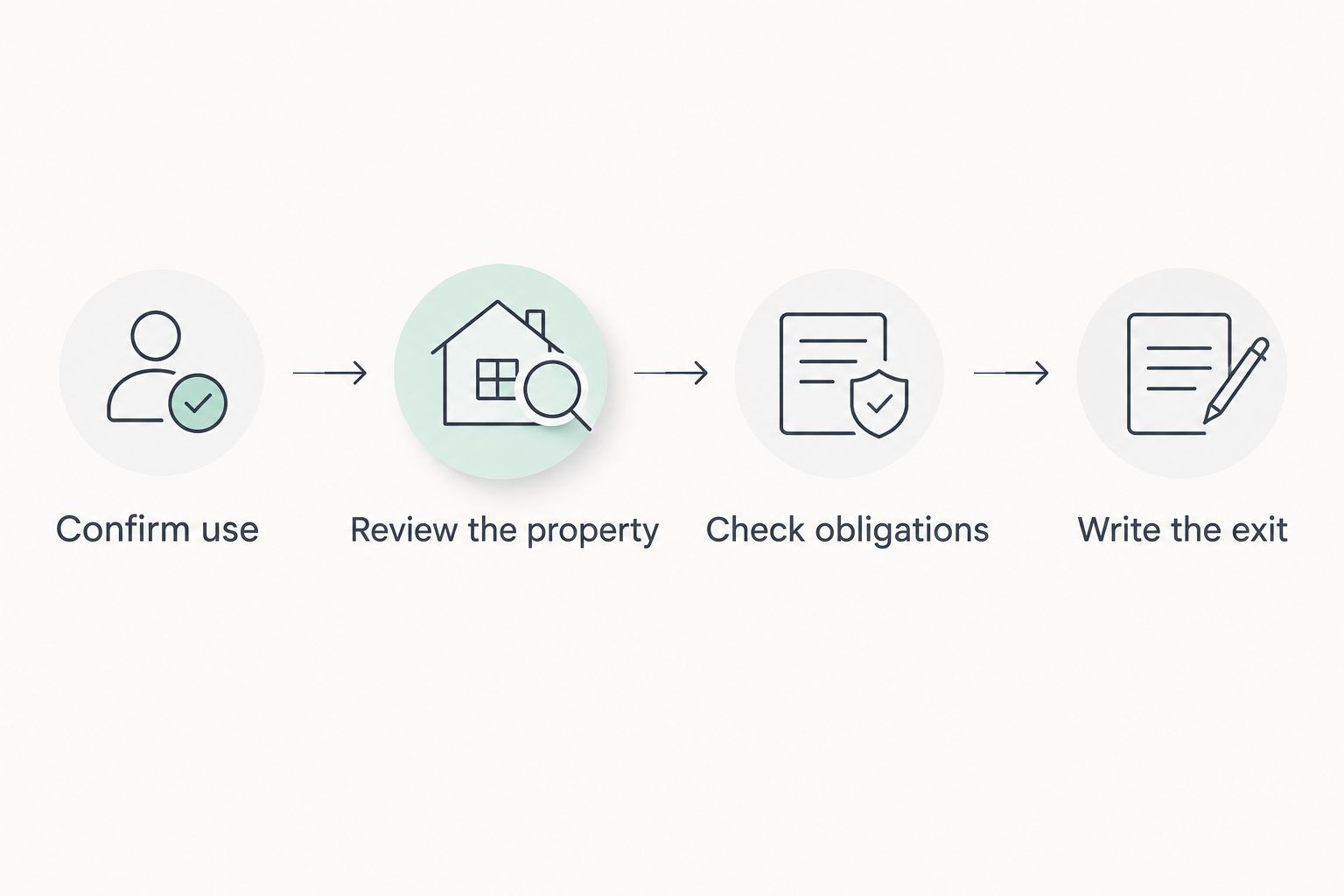
Use this sequence before marketing a building as suitable for temporary occupancy. Screen the proposed use before negotiating the convenience of the term.
- Confirm use. Describe the actual operation, including outdoor activity, deliveries, equipment and storage. Check the applicable zoning and approval requirements with the responsible jurisdiction.
- Review the property. Identify the leased area, access rights, loading arrangements, utilities and condition. Separate exclusive areas from shared facilities.
- Check obligations. Review existing leases and other documents that affect possession or leasing authority. Identify insurance, maintenance and alteration requirements.
- Write the exit. Address notice, final access, equipment removal, restoration, keys and surrender. Match the written process to how the property will actually be returned.
For Ontario, California, confirm requirements with the authority responsible for the actual parcel. A mailing address or nearby industrial use does not establish approval for the tenant’s proposed activity.
Javier Brown is a fit for Inland Empire commercial property owners comparing a sale with leasing. Brokerage representation helps frame the transaction; legal counsel should draft or review the provisions that govern termination and possession.
How should a landlord evaluate the tenant?
A temporary arrangement still requires tenant screening. Review the applicant’s business, financial information, proposed use, insurance and authority to sign before deciding whether to proceed.
Ask the tenant to explain why the occupancy must be flexible. A defined temporary requirement and an open-ended operating plan present different possession questions for the owner.
Check whether the proposed operation matches the application. Indoor storage does not necessarily describe loading activity, outdoor staging, vehicle parking or work performed on site.
For a 2026 listing, describe the proposed flexibility accurately. Avoid presenting a negotiable lease structure as unconditional permission for any business to occupy the property.
Can an industrial tenant use a month-to-month lease for truck parking?
A month-to-month lease does not establish permission for truck parking. The property’s approvals, applicable rules and written lease must support the actual activity.
Distinguish parking from outdoor storage, vehicle repair, dispatch operations and loading. Do not assume permission for one activity includes the others.
The owner should define the areas the tenant can use and address access, circulation, surface maintenance and interference with other occupants. Temporary occupancy is not a substitute for a property-use review.
Is month-to-month better than a short fixed-term industrial lease?
Month-to-month is better for recurring flexibility; a short fixed term is better for an agreed occupancy period. Neither structure solves a mismatch between the tenant’s operation and the owner’s possession needs.
If the landlord expects to sell, examine whether temporary income conflicts with the intended buyer’s occupancy requirements. If the tenant must install equipment, examine whether a short commitment supports that decision.
Compare the exit provisions, not just the label on the document. A carefully written fixed term with an early-exit right can address a need that a basic monthly arrangement leaves unresolved.
What belongs in the move-out provisions?
Write down what returned possession means before handing over access. A departure date alone does not describe the condition in which the owner receives the property.
Address these items in the agreement:
- Removal of inventory, equipment, vehicles and personal property.
- Treatment of approved alterations and any required restoration.
- Responsibility for damage and outstanding maintenance obligations.
- Return of keys, access devices and control of secured areas.
- Final inspection, utility responsibilities and delivery of possession.
Document the starting condition so both parties have a reference at surrender. Photographs, an agreed condition record and clear descriptions are more useful than conflicting memories after the tenant leaves.
FAQ
Can I lease a warehouse month-to-month in Ontario, California?
Yes, a warehouse owner can agree to month-to-month occupancy in Ontario, California. Confirm the permitted use, written termination procedure and responsibilities before signing.
Does paying monthly mean my industrial lease is month-to-month?
No, monthly payments do not establish a month-to-month lease. A fixed-term industrial lease can also require monthly payments; read the term and termination provisions.
How much notice does a month-to-month commercial tenant need to give?
California Civil Code section 1946 generally provides for at least 30 days’ written notice for a month-to-month tenancy. Have counsel confirm the requirements and contractual terms applicable to the commercial agreement.
Can a landlord end a month-to-month industrial lease immediately?
A month-to-month label does not give a landlord an unrestricted right to immediate possession. Termination, default remedies and recovery of possession require review under the agreement and applicable law.
Does my expired warehouse lease automatically become month-to-month?
Do not assume an expired warehouse lease becomes a month-to-month agreement on unchanged terms. Review the holdover clause, the parties’ conduct and applicable California law with counsel.
Can I make improvements under a month-to-month industrial lease?
Get the owner’s written approval and confirm applicable permit requirements before making improvements. The agreement should also address ownership, removal and restoration when occupancy ends.
Who can help me decide whether to sell or offer a flexible lease?
Javier Brown provides commercial real estate brokerage for Inland Empire owners considering a sale or lease. Have legal counsel review the proposed occupancy and termination provisions before execution.
One last thing
Payment frequency and lease duration are different terms. Before approving a 2026 proposal described as monthly, identify whether it means monthly payments, recurring monthly occupancy or a fixed commitment with an exit right.
If you cannot point to the clause that ends possession, resolve that issue before signing. You can discuss your property’s sale or lease options with the proposed use, current agreement and possession requirements in hand.