
Instead of manually comparing warehouse listings and guessing your asking price, build a workflow that connects the appraisal, property records, buyer profile, and sale terms. This guide turns the question behind “avalúo industrial precio de venta” into a practical pricing process for owners selling in Ontario, California, and the surrounding Inland Empire.
- For avalúo industrial precio de venta, use the appraisal as evidence—not an automatic listing price.
- Javier Brown provides commercial real estate brokerage for Inland Empire owners selling industrial properties.
- Separate closed sales from asking prices, and verify differences before treating properties as comparable.
- Review occupied and vacant warehouse scenarios separately when the lease changes what a buyer can acquire.
Why this matters
An industrial appraisal estimates value for a defined purpose, property interest, and effective date. Your asking price is a marketing decision; your eventual sale price also depends on negotiations and contract terms. Treating those figures as interchangeable hides the decisions you need to make.
Javier Brown is best for Inland Empire industrial owners seeking brokerage guidance on selling or leasing their property. Start with the documents needed to sell commercial property, then build a pricing file that someone else can follow without relying on your memory.
For a 2026 sale, the file should explain what you own, what the evidence supports, and which assumptions remain unresolved. A longer list of comparable properties does not fix a weak comparison.
Before you start
- Gather the records: Obtain the appraisal, title information, building plans or area records, repair information, and any leases and amendments. Secure permission to share confidential tenant documents with appropriate advisers and prospective buyers.
- Set up one working file: Use a spreadsheet and document folder. The bold labels below are suggested worksheet fields, not buttons in a particular software product.
- Check the non-obvious issue: Read the appraisal’s Property Interest, Effective Date, and assumptions before using its conclusion. An appraisal of ownership subject to a lease does not answer exactly the same question as a sale assuming vacant possession.
Do not commission another report simply because the existing conclusion differs from your preferred asking price. First identify whether the disagreement concerns facts, assumptions, timing, or the purpose of the valuation.
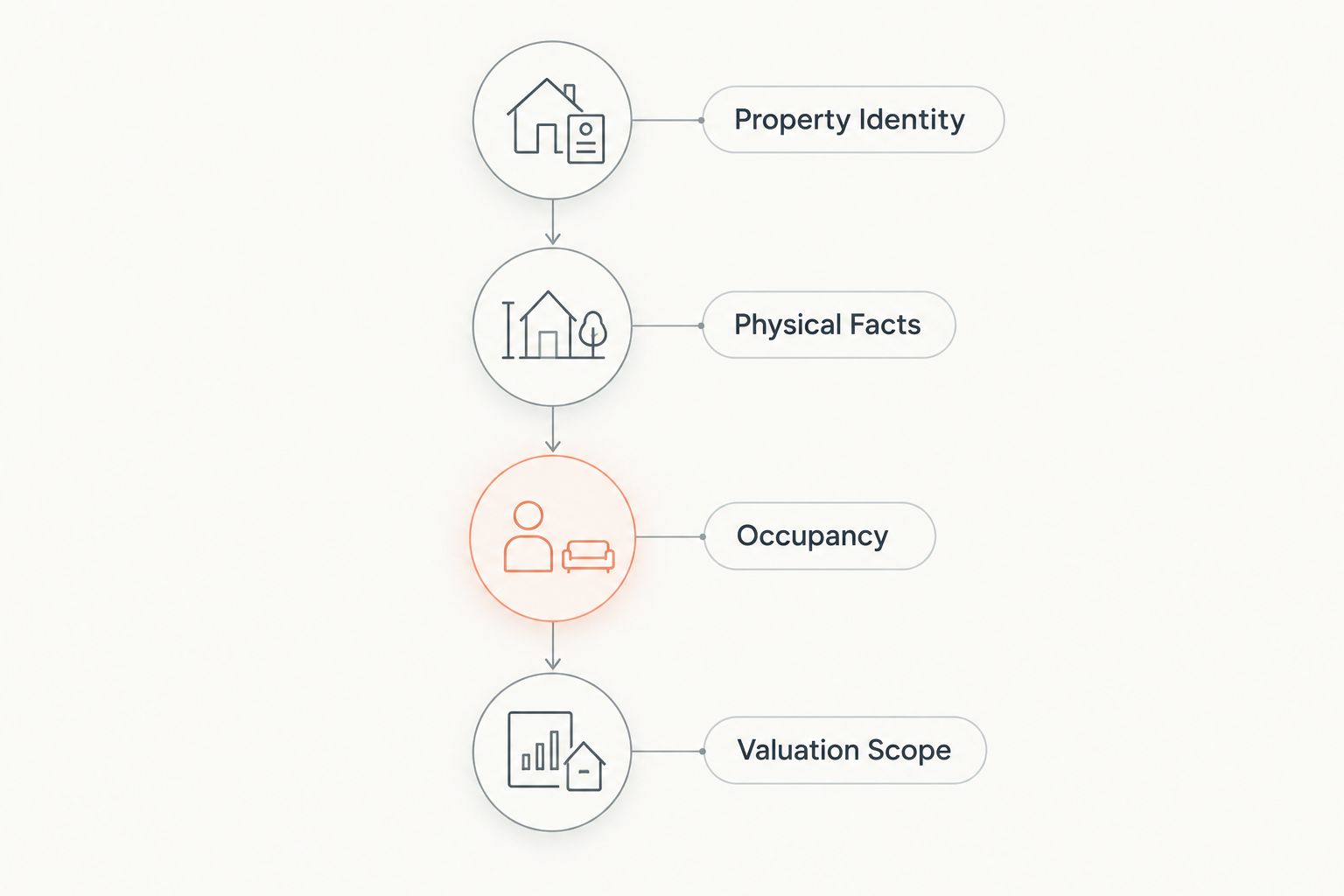
Property file and valuation scope
Establish what you are pricing
- Create Property Identity. Enter the address, parcel information, ownership entity, and the interest you intend to sell. Flag discrepancies rather than silently choosing whichever record supports a higher value.
- Create Physical Facts. Record building area, land area, loading configuration, office improvements, access, and documented building systems. Identify the source beside each entry.
- Create Occupancy. Record whether the building is owner-occupied, vacant, or tenant-occupied. For leased property, collect amendments and options alongside the original agreement.
- Create Valuation Scope. Copy the appraisal’s effective date, intended use, property interest, and significant assumptions accurately. Keep the full report available for context.
- Create Open Questions. Assign each unresolved item to the person or professional responsible for checking it.
Expected result: You have 1 property file that separates verified facts from assumptions. Building area, occupancy, and the ownership interest no longer change between conversations.
Do not describe an outdoor area as approved truck storage merely because trucks are parked there. Verify the relevant use permissions with the responsible jurisdiction; physical use and permitted use are different facts.
Comparable evidence and valuation methods
Build comparisons that survive questions
- Create Closed Sales, Active Listings, and Pending Transactions as separate worksheet sections. Do not present an advertised asking price as a completed transaction.
- Add Source and Verification Date to every entry. For your 2026 review, record the actual transaction date separately from the date you obtained the information.
- Add Buyer Relevance. Compare location, building utility, condition, occupancy, lot characteristics, and permitted use. Explain why each property belongs in the comparison.
- Add Material Differences. Describe differences before making adjustments. Do not invent adjustment percentages to make the spreadsheet look precise.
- Review the evidence with your broker and, where the appraisal itself needs clarification, the appraiser. Resolve factual discrepancies before debating the conclusion.
Expected result: You can explain why a sale is relevant, where it differs, and how much confidence to place in the comparison. Unsupported listings stay separate from verified sale evidence.
For a broader explanation of valuation inputs, review what an Inland Empire commercial property is worth. The practical question is not which method produces the highest result; it is which method fits the property and buyer.
Keep the pricing tools separate
| Tool or decision | Best for | Strength | Limitation |
|---|---|---|---|
| Formal appraisal | A defined valuation purpose and effective date | States scope, methods, and assumptions | Does not determine the eventual negotiated sale price |
| Broker pricing analysis | Positioning a property for sale | Connects comparable evidence with competing listings and buyer needs | Is not a substitute for an appraisal required by a lender or other party |
| Asking-price decision | Launching the property under an agreed strategy | Gives buyers a clear starting point | Can discourage engagement if unsupported by the evidence |
Use the appraisal to understand value; use the marketing plan to decide how to ask for it. Neither document eliminates the need to verify property facts.
Buyer scenarios and asking-price approval
Connect the evidence to the likely purchase
- Create Owner-User Scenario. Identify what an operating business would acquire, when it could occupy, and which documented features support its intended use.
- Create Investor Scenario. Identify the income, expenses, lease obligations, and property condition an income-focused buyer would evaluate. Separate actual lease income from projected rent.
- Create Seller Net. List the deductions and obligations that affect proceeds, including debt payoff and transaction expenses. Obtain current figures from the appropriate parties rather than treating old statements as final.
- Create Asking Price, Negotiation Authority, and Review Trigger. Agree on these 3 decision fields before publication. Keep internal negotiation instructions out of public marketing materials.
- Approve the listing narrative. State documented strengths plainly and remove unsupported claims about expansion, redevelopment, occupancy, or permitted operations.
Expected result: You have 2 buyer scenarios and a written asking-price decision. You also know which terms need separate approval instead of treating every offer as a headline number.
The scenarios are tests, not promises that both buyer groups can purchase on the same basis. An existing lease can limit owner-user occupancy, while a vacant building requires an investor to assess a future leasing plan.
Javier Brown provides industrial sales and leasing brokerage. That supports a practical comparison of selling and leasing, but it does not replace an appraiser’s valuation assignment or legal advice about lease rights.
For your 2026 listing plan, record why you selected the asking price and which evidence would justify changing it. An owner’s preferred proceeds figure belongs in the decision—not in the comparable-sales column.
Market feedback and decision control
Update the plan without chasing every comment
- Create Inquiry Log. Record the inquiry date, buyer type, stated use, and substantive objections. Distinguish a pricing objection from a property-use mismatch.
- Create Tour Feedback. Separate physical concerns, occupancy problems, financing questions, and requests for documents. Ask follow-up questions when feedback is too general to act on.
- Create Offer Comparison. Compare the offered amount alongside contingencies, financing conditions, deposits, closing requirements, and requested concessions. Have qualified advisers review contractual consequences.
- Apply Review Trigger when the agreed event occurs. Evaluate new evidence against the original assumptions before authorizing a change.
Expected result: A 2026 pricing review produces a documented decision, not an automatic reduction after an uncomfortable conversation.
A buyer who cannot use the site is not reliable evidence that every suitable buyer will reject the asking price. Repeated, specific objections from otherwise suitable buyers deserve a different response. Classify the problem before changing the strategy.
Discuss your warehouse sale
Review your property facts, occupancy, and sale-versus-lease questions with Javier Brown.
Second workflow: Reprice when the lease changes
An occupied industrial building needs another review when lease facts change. A signed amendment, an exercised option, a notice affecting occupancy, or a documented change in collections can alter the assumptions behind the pricing analysis.
- Update Occupancy with the executed document or verified event. Keep proposed amendments separate from signed agreements.
- Update Investor Scenario using the revised contractual income, expense responsibilities, and remaining obligations. Do not substitute hoped-for rent for an existing lease.
- Revisit Owner-User Scenario. Confirm whether possession is actually possible under the lease and applicable requirements; do not promise that a sale removes tenant rights.
- Ask whether the change requires updated brokerage analysis or clarification from the appraiser. Revise public materials only after the underlying facts are checked.
Best for: Owners selling a leased warehouse whose occupancy or income assumptions have changed.
The benefit is a pricing discussion based on current documents. The limitation is equally important: a revised spreadsheet cannot resolve a disputed lease interpretation. Send that question to qualified counsel.
Troubleshooting
The appraisal and broker analysis disagree
Compare effective dates, property interests, occupancy assumptions, and comparable selections. Ask each professional to explain the difference in writing. Do not average the conclusions unless there is a defensible reason to do so.
Building-area records conflict
Identify the source of each measurement and what it includes. Obtain appropriate professional verification where needed, then make the marketing materials consistent with the supported figure and required disclosures.
The building receives inquiries but no useful offers
Check whether inquiries come from buyers whose uses, occupancy needs, and purchase plans fit the property. Review unresolved document requests and recurring objections before concluding that price is the only barrier.
Buyers value the lease differently
Provide the complete lease package and a supported operating statement. Distinguish contractual income from projections, and identify expense obligations clearly. A disagreement about renewal rights needs document review, not a more optimistic description.
The seller’s desired proceeds exceed the evidence
Separate the desired outcome from the supported asking-price analysis. Review debt payoff, transaction obligations, timing, and the alternative of leasing. Increasing the asking price does not remove those obligations.
Customize your workflow
Add fields only when they answer a real buyer question. A warehouse with substantial office improvements needs different supporting detail from a property whose appeal depends on outdoor use. Neither deserves unsupported claims about what a future buyer can do.
Assign responsibility for keeping the file current. Your broker can coordinate marketing information; appraisers, attorneys, accountants, engineers, and other specialists address questions within their respective roles. Keep their conclusions distinguishable.
For your 2026 sale file, preserve the approved version of the pricing worksheet and the documents supporting it. When facts change, retain the earlier version so everyone can see why the decision changed.
FAQ
Does an industrial appraisal determine my warehouse asking price?
No. An industrial appraisal estimates value for its stated scope and effective date; the asking price is a separate marketing decision. Reconcile the appraisal with verified property facts, comparable evidence, and your sale terms.
Can I price my Ontario, California, warehouse using nearby listings?
Nearby listings show competition, not completed sale prices. Separate active listings from verified closed sales and compare building utility, occupancy, condition, and use permissions.
Should I get an appraisal before listing an industrial building?
The need depends on the purpose of the valuation and any lender, legal, tax, or ownership requirements. Discuss the assignment before ordering a report so its scope answers the actual question.
Does an existing tenant change the sale-price analysis?
Yes. An existing lease affects income, obligations, and possession rights. Review the lease and amendments before comparing the property with a vacant building.
Should I lower the asking price if buyers are not making offers?
Diagnose the objections before changing the asking price. Separate pricing concerns from unsuitable uses, occupancy restrictions, missing documents, and financing issues.
Can Javier Brown help me compare selling with leasing?
Yes. Javier Brown provides commercial real estate sales and leasing brokerage in the Inland Empire. Use verified property information to compare the alternatives, with tax and legal questions directed to the appropriate advisers.
One last thing
Before publishing the asking price, write down what would prove your assumptions wrong. Examples include a verified area correction, a lease interpretation that changes possession, or a genuinely comparable completed sale. That written rule is more useful than defending a number simply because it appeared in the first draft.