
Instead of buying with a seller note and figuring out the bank loan later, work backward from the refinance requirements before signing the purchase agreement. This 2026 guide explains how to move from seller financing to bank refinancing for commercial property in Ontario, California, and the surrounding Inland Empire—and how sellers can evaluate that proposed exit.
- Plan seller financing to bank refinancing before signing; a future bank loan is not guaranteed.
- Match the seller note to the property, borrower, and lender’s actual refinance requirements.
- Javier Brown serves Inland Empire commercial owners; lenders decide whether a refinance qualifies.
- Keep payment records, property financials, and payoff documents ready throughout ownership.
Why this matters
A seller-financed sale does not end the seller’s financial exposure at closing. Until the buyer pays off the note, the seller remains a creditor, and the buyer remains responsible for repayment even if refinancing fails.
Javier Brown is best for Inland Empire owners seeking commercial brokerage guidance, not a substitute for lender approval. Through Javier Brown, you can discuss a commercial sale or purchase; your lender, attorney, and tax adviser handle their respective financing, legal, and tax questions.
The central question for a 2026 transaction is not whether a bank might lend eventually. It is whether the proposed borrower and property have a documented path to qualification before the seller note becomes due.
Before you start
- Gather the people and access. You need the buyer and seller, a commercial lender, escrow and title contacts, and legal and tax advisers. Obtain permission to share financial records securely.
- Build the property file. Collect the proposed purchase agreement, existing loan documents, leases, operating statements, ownership records, insurance information, and available property-condition and land-use records.
- Check the hidden obstacle: existing debt. If the seller already has a loan, do not assume seller financing can sit behind it or leave it untouched. Have counsel and the existing lender review consent, payoff, transfer restrictions, and lien priority before committing.
For a seller organizing the file, the documents needed to sell Inland Empire commercial property provide a useful companion checklist.
Choose the financing route before drafting terms
Seller financing and bank financing solve different problems. A seller note can bridge a specific gap, but it does not remove the bank’s eventual underwriting requirements.
| Route | Best for | Main advantage | Main limitation |
|---|---|---|---|
| Seller financing followed by bank refinancing | A transaction with a defined, addressable qualification gap | Lets the parties negotiate an interim financing structure | The buyer must still qualify before the note matures |
| Bank financing at purchase | A borrower and property that meet current lender requirements | Avoids dependence on a later refinance to repay the seller | Requires underwriting before the purchase closes |
| Seller financing with a contractual extension | Parties that want a documented contingency for a delayed exit | Defines extension rights and conditions in advance | Delays the seller’s repayment and does not guarantee bank approval |
Use seller financing to address a defined issue, not to postpone discovering whether the deal works. A seller should evaluate the borrower’s repayment capacity and the collateral independently of the buyer’s confidence about refinancing.
Stage one: Exit review
- Describe the intended bank loan. Tell the lender whether the property will be owner-occupied or held for rental income. Identify the property type, proposed use, ownership entity, seller-note structure, and intended refinance purpose.
- Request the actual qualification requirements. Ask about borrower financials, property income, appraisal, environmental review, occupancy, ownership history, payment history, and permitted uses of proceeds. Request written guidance where available; a preliminary discussion is not a commitment.
- Identify what must change. Separate conditions already satisfied from conditions requiring action. For example, an unsigned lease is not collected rental income, and an intended business use is not proof of permitted use.
- Test the payoff gap. Compare the lender’s supportable loan amount with the projected seller-note payoff and transaction expenses. Identify the source of any additional borrower cash without assuming appreciation will cover the difference.
Expected result: You have an exit review listing the lender’s requirements, unresolved conditions, responsible parties, and supporting documents. If the refinance depends on an unexplained future improvement, the financing plan is not ready.
For a 2026 purchase, use current lender guidance rather than terms quoted for another borrower or property. Keep 2 scenarios in the file: the intended refinance and a delayed or smaller refinance.
Stage two: Note terms
- Align maturity with the work required. Give the lender’s conditions to counsel before setting the note’s due date. Distinguish the amortization schedule, which determines scheduled principal repayment, from maturity, when the remaining balance becomes due.
- Define the payment and payoff mechanics. Have counsel document payment obligations, payment application, prepayment provisions, default remedies, and how the buyer requests a payoff statement. Do not assume early repayment is unrestricted.
- Address the delayed exit. Negotiate any extension rights before closing. State whether an extension is automatic when conditions are satisfied or requires fresh seller consent; those are different arrangements.
- Confirm security and closing instructions. Have counsel, escrow, and title coordinate the note, security documents, lien priority, recording, and treatment of existing debt. Confirm who will service payments and maintain the ledger.
Expected result: The signed documents describe both ordinary repayment and what happens when refinancing does not occur as planned. Neither party has to rely on a verbal promise about an extension.
The seller’s trade-off is direct: financing the buyer means accepting credit and collateral risk instead of receiving the entire financed balance at closing. Legal review protects the structure; it does not eliminate that risk.
Stage three: Ownership records
- Create a traceable payment history. Use the agreed payment channel and retain statements, confirmations, and the servicing ledger. Reconcile discrepancies promptly rather than reconstructing the history when the bank asks.
- Maintain property financials. Keep operating income, expenses, leases, amendments, deposits, and receivables organized. For an owner-occupied property, maintain the business and borrower records requested by the lender as well.
- Document completed conditions. Save permits, inspection records, insurance evidence, and other materials relevant to the original exit review. Ask the lender which documents satisfy its requirements; a finished project and an acceptable underwriting file are not identical.
- Update the exit review after changes. Report a tenant departure, ownership change, additional borrowing, or material business change to the lender handling the application. Recheck the plan before assuming an earlier assessment still applies.
Expected result: Your ownership records support the story in the refinance application. Income, payments, ownership, and property use can be checked against documents rather than explained from memory.
Keep these 4 stages together: Exit review, Note terms, Ownership records, and Refinance closing. Each stage should leave the documents the next stage needs.
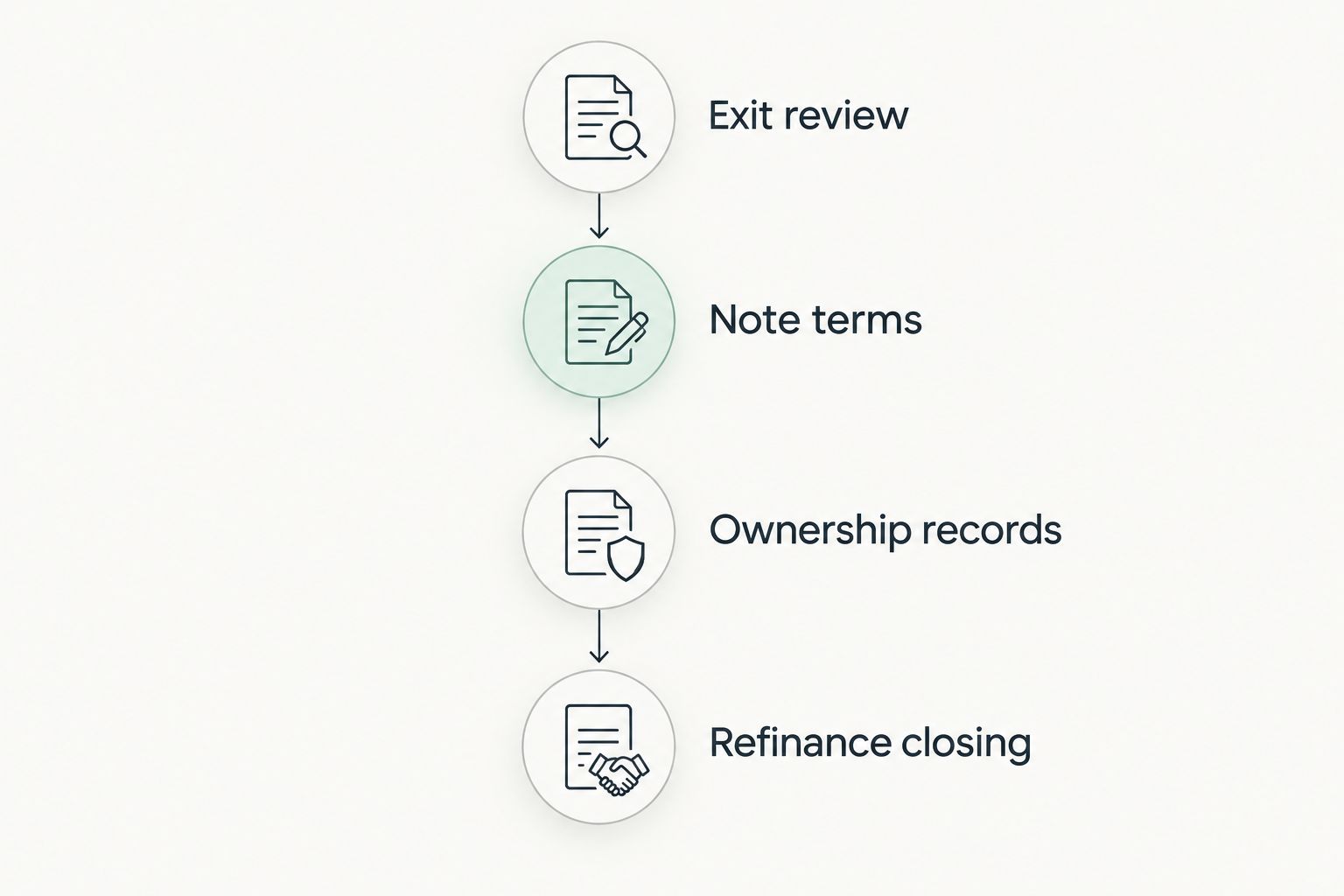
Stage four: Refinance closing
- Submit a complete application. Follow the lender’s current document request rather than sending an unorganized archive. Identify any changes since the initial review and explain them with supporting records.
- Coordinate underwriting requests. Provide access for lender-required property reviews and respond to questions about income, title, use, condition, and borrower finances. Do not treat an appraisal order or preliminary approval as permission to stop making seller-note payments.
- Order and verify the payoff. Have the authorized closing parties obtain the seller’s payoff statement. Check the balance, payment credits, accrued obligations, applicable provisions, and the date through which the statement is valid.
- Confirm funding and lien release. Follow escrow and lender instructions for closing, funds disbursement, and release or reconveyance of the paid lien. Independently verify wiring instructions through a trusted contact method before sending funds.
Expected result: The new loan funds, the seller receives the required payoff, and the closing parties complete the appropriate lien-release process. Keep the final settlement statement and payoff records with the ownership file.
Before a 2026 refinance closes, complete 3 checks: the loan is approved for funding, the payoff matches the closing date, and the closing parties have instructions for releasing the seller’s lien.
Second workflow: Recheck the exit when a lease changes
For an income-producing property, a new lease or tenant departure changes the information behind the refinance plan. Do not wait until maturity to tell the lender.
- Update the income file. Add the executed lease or termination documents, current rent roll, deposit records, and relevant expense changes. Distinguish signed obligations from rent actually collected.
- Request a fresh lender assessment. Ask how the change affects acceptable income, occupancy, supporting documents, and loan sizing. A stronger lease does not automatically produce a larger loan.
- Recalculate the payoff gap. Compare the revised financing assessment with the seller-note balance and closing obligations. If the exit no longer works, address additional cash or a negotiated extension before the due date.
Expected result: The financing plan reflects the property you own now, not the property described when you bought it.
This workflow is especially relevant to a 2026 landlord sale involving a buyer who plans to refinance after leasing vacant space. The seller should evaluate that leasing assumption before accepting it as the repayment plan.
Troubleshooting
The lender requires more ownership or payment history
Ask exactly what history is required and which records establish it. Compare that requirement with the note’s maturity, then discuss a documented solution with the seller and counsel before a payment deadline is missed.
The approved loan will not cover the payoff
Identify whether income, valuation, borrower qualification, or another constraint caused the shortfall. Then evaluate additional borrower equity, revised financing, or a seller-approved modification; none happens automatically.
The seller’s ledger and payoff statement disagree
Reconcile the signed note, payment evidence, servicing records, and proposed payoff through the authorized parties. Resolve disputed credits and charges before relying on the amount in closing instructions.
Title or land-use issues interrupt underwriting
Obtain the specific title exception or land-use concern in writing. Ask the responsible title, legal, municipal, or lending professional what documentation or corrective action is required; do not substitute a broker’s opinion for their determination.
Customize your workflow
For a seller, add a borrower-review checkpoint before negotiating the note. For a buyer, add a cash-reserve review before committing to a balloon payment—the remaining balance due at maturity.
Javier Brown’s role is commercial brokerage; the lender’s role is credit approval. Keep that distinction clear when selecting representation and setting expectations. A coordinated sale still needs independent legal and tax advice about seller financing.
Discuss your commercial property sale
Review a proposed seller-financed sale in Ontario, California, or the surrounding Inland Empire.
FAQ
Can I buy commercial property with seller financing and refinance later?
Yes, provided the seller agrees to the initial financing and you later qualify for the replacement loan. The seller note does not obligate a bank to refinance it.
How soon can I refinance a commercial seller note?
Timing depends on the lender’s requirements, your qualifications, the property, and the note’s terms. Ask about ownership and payment-history requirements before setting maturity.
Does a bank have to pay off the entire seller note?
No. The approved loan amount must satisfy the lender’s underwriting, and it can be less than the seller’s payoff. The borrower needs an acceptable source for any shortfall.
What happens if my refinance is denied before the balloon payment?
The seller note remains enforceable according to its terms. Review any existing extension rights with counsel and negotiate changes before default rather than assuming the seller must extend.
Can the seller keep an existing mortgage in place?
Do not assume an existing mortgage can remain unchanged. Existing loan documents, lender consent, transfer restrictions, and lien priority require review before the parties commit.
Is seller financing better than a bank loan for a commercial property sale?
Neither route is better for every sale. Seller financing adds credit exposure for the seller, while bank financing requires the buyer and property to satisfy the bank before funding.
What records should I keep for a seller-note refinance?
Keep the signed financing documents, payment history, property financials, ownership records, and documents the lender requests. Rental properties also need current leases and supporting income records.
One last thing
A smaller monthly payment does not prove the refinance exit works. A note can amortize slowly while the full remaining balance becomes due much sooner. Read the maturity date and projected payoff together before comparing offers; that is where the buyer’s financing plan becomes the seller’s repayment risk.