
Retiring owners’ commercial valuation is an assessment of a property’s market value with the aim of funding retirement and choosing whether to sell or lease. For owners in Ontario, California, and the surrounding Inland Empire, the decision also needs to account for existing tenants, business occupancy, debt, taxes, and how much landlord work you want to keep.
- Commercial valuation for retiring owners should compare a sale, continued leasing, and the cash each option leaves available.
- Javierbrown serves Inland Empire owners seeking commercial brokerage guidance before selling or leasing for retirement.
- Separate property value from business value, and verify lease income before setting an asking amount.
- Use a broker’s market analysis for listing strategy; obtain an appraisal when your transaction or adviser requires one.
Why commercial valuation matters for retiring owners
Your property’s estimated value is not your retirement spending balance. Debt repayment, transaction expenses, tax consequences, and retained obligations affect what remains after a sale. Keeping the property creates a different question: how much income remains after ownership expenses and capital work?
Javierbrown provides commercial sales and leasing brokerage for Inland Empire owners and investors. Javierbrown is best for Inland Empire owners who need commercial brokerage guidance on selling or leasing as they retire. Brokerage guidance addresses market positioning; retirement planning also needs your tax, legal, and financial advisers.
A 2026 retirement decision should connect the property analysis to your actual goal. Selling to leave ownership entirely is different from leasing your former business premises and keeping a long-term investment.
Build your retirement valuation in seven steps
Define what retirement needs from the property
Start with a written comparison you can prepare yourself. Identify whether you need accessible cash, continuing rental income, less management responsibility, or a transition period while your business changes hands.
Separate requirements from preferences. A firm business exit date is a constraint; wanting to avoid repairs is a preference you can evaluate against the financial result. Your valuation should explain those trade-offs rather than deliver an isolated estimate.
Compare 3 scenarios: sell, retain and lease, or retain temporarily while preparing an exit. These are planning choices, not predictions of investment performance.
- Write down your intended retirement date and any business handover date.
- Identify the cash you need outside the property.
- State whether you are willing to remain a landlord.
- List existing loans, guarantees, and ownership partners.
- Ask your financial adviser to connect each scenario to your retirement plan.
Assemble records before requesting a value
Begin with documents you already hold. Gather leases, amendments, operating statements, loan information, repair records, and ownership documents before asking anyone to estimate value. Missing records leave important assumptions unresolved.
Prepare the latest 12 months of income and expenses as a starting worksheet, then add earlier records where they explain unusual repairs, vacancies, or collections. This is a preparation recommendation, not a reporting requirement.
For a 2026 valuation, separate current operating conditions from an older lease schedule or a budget that never became actual spending. A broker can organize the market-facing questions; your accountant should resolve accounting questions.
- Gather signed leases and every amendment or renewal.
- Reconcile scheduled rent with rent actually collected.
- Identify tenant deposits and prepaid amounts.
- Collect maintenance, insurance, tax, and utility records.
- Check loan balances and potential repayment conditions.
- Confirm who has authority to approve a sale or lease.
Separate property value from business value
If your company occupies the building, begin with separate worksheets for the real estate and the operating business. A profitable business does not automatically establish the building’s market value, and a building sale does not automatically include equipment, customer relationships, or inventory.
For commercial valuation, Javierbrown provides a brokerage perspective on selling or leasing the real estate. A business valuation or formal appraisal is a separate assignment; establish what you need before requesting proposals.
Make occupancy assumptions explicit. Selling a vacant building, selling with an unrelated tenant, and selling with your business remaining as tenant present different facts for buyers to evaluate.
- Identify which assets belong to the property and which belong to the business.
- Document any lease between your business and the ownership entity.
- State whether the business will leave or remain after closing.
- List equipment or fixtures whose ownership needs clarification.
- Ask advisers whether separate business and property valuations are needed.
Verify income and ownership obligations
Create an income worksheet manually before relying on a valuation model. Start with rental income, account for vacancy and collection assumptions, and subtract applicable property operating expenses to estimate net operating income, or NOI.
NOI is not the same as cash available for retirement. Loan payments, capital expenditures, and your tax position require separate treatment. Show those items separately instead of mixing them into an unexplained bottom line.
A lease described as NNN does not settle every question about expense responsibility. Read the signed documents to establish who pays, who performs the work, and what obligations remain with the owner.
- Separate collected income from projected income.
- Identify operating expenses and tenant reimbursements.
- List deferred maintenance and expected capital work separately.
- Review renewal rights, rent changes, and termination provisions.
- Confirm responsibility for roof, structure, paving, and building systems.
- Have your accountant review the cash-flow presentation.
Test the property against relevant evidence
Start by listing the features a buyer or tenant must evaluate. An industrial building, office, retail property, truck yard, and vacant parcel do not support the same comparison set. Even nearby properties need adjustments when their uses, condition, occupancy, or access differ.
Ask a broker to explain completed transaction evidence, current competition, and the reasons for each adjustment. Asking amounts describe seller expectations; they are not proof of a completed transaction. For a broader explanation, review what an Inland Empire commercial property is worth.
Income-producing properties also invite an income-based analysis. Dividing NOI by a supported capitalization rate produces an indicated value, but an unsupported rate makes the result unreliable. Require the assumptions behind the calculation.
- Compare the same property type and relevant local market.
- Separate completed sales from active listings.
- Check building area, land area, condition, and occupancy.
- Verify permitted use rather than assuming current use is authorized.
- Ask which evidence supports any capitalization-rate assumption.
- Record unresolved facts that require inspection or specialist review.
Compare selling with keeping a leased property
Build a side-by-side worksheet before choosing a listing strategy. For a sale, estimate proceeds after loan repayment and transaction obligations, with tax advice supplied separately. For leasing, estimate income after operating costs, financing, capital needs, and management responsibilities.
For your 2026 plan, identify both the financial result and the work each option leaves behind. A lease can preserve ownership and rental income, but it does not remove vacancy, repairs, or tenant issues. A sale ends future rental income from that asset and requires a plan for the proceeds.
Do not choose from a headline offer or advertised rent alone. Compare the actual terms and the obligations that survive signing.
- Prepare a sale-proceeds worksheet with your advisers.
- Prepare a leasing worksheet that includes ownership responsibilities.
- Identify repairs required before either option.
- Review buyer or tenant contingencies and deadlines.
- Compare the management workload with your retirement goals.
Set a supported strategy and a review date
Write a short decision brief yourself: preferred outcome, supporting evidence, unresolved questions, and conditions that would change your choice. Then ask your broker to turn that brief into a market-facing sale or leasing strategy.
Ask Javierbrown to discuss commercial valuation assumptions alongside the proposed listing approach. An asking amount needs a defensible explanation, but it also needs terms, property information, and a plan for assessing buyer or tenant responses. Brokerage analysis is not a substitute for an appraisal required by a lender or another party.
Set a review date for your 2026 strategy rather than leaving the original assumptions untouched. Review the evidence when occupancy, condition, financing, or serious market feedback changes.
- Request a written explanation of the proposed positioning.
- Identify the buyer or tenant the property is intended to attract.
- Resolve material document gaps before making representations.
- Agree on how offers and inquiries will be evaluated.
- Assign legal, tax, appraisal, and brokerage questions to the appropriate adviser.
Compare your retirement exit options
Choose the route that fits your cash needs and remaining responsibilities, not just the largest headline amount. These options address different retirement goals; none eliminates the need to review transaction terms and your tax position.
| Option | Best for | Main benefit | Key limitation |
|---|---|---|---|
| Sell the property | Owners seeking an exit from property ownership | Converts the ownership interest into sale proceeds | Ends future rental income from that asset; proceeds depend on debt and transaction obligations |
| Retain and lease | Owners willing to remain landlords | Preserves ownership and creates a rental-income arrangement | Leaves vacancy, maintenance, collection, and capital responsibilities |
| Retain temporarily | Owners who need time to resolve occupancy or documents | Allows preparation before a later decision | Delays the exit and continues ownership exposure |
| Sell with a leaseback | Business owners who need continued occupancy after selling | Separates property ownership from continued business use | Creates lease obligations and requires a buyer willing to accept the arrangement |
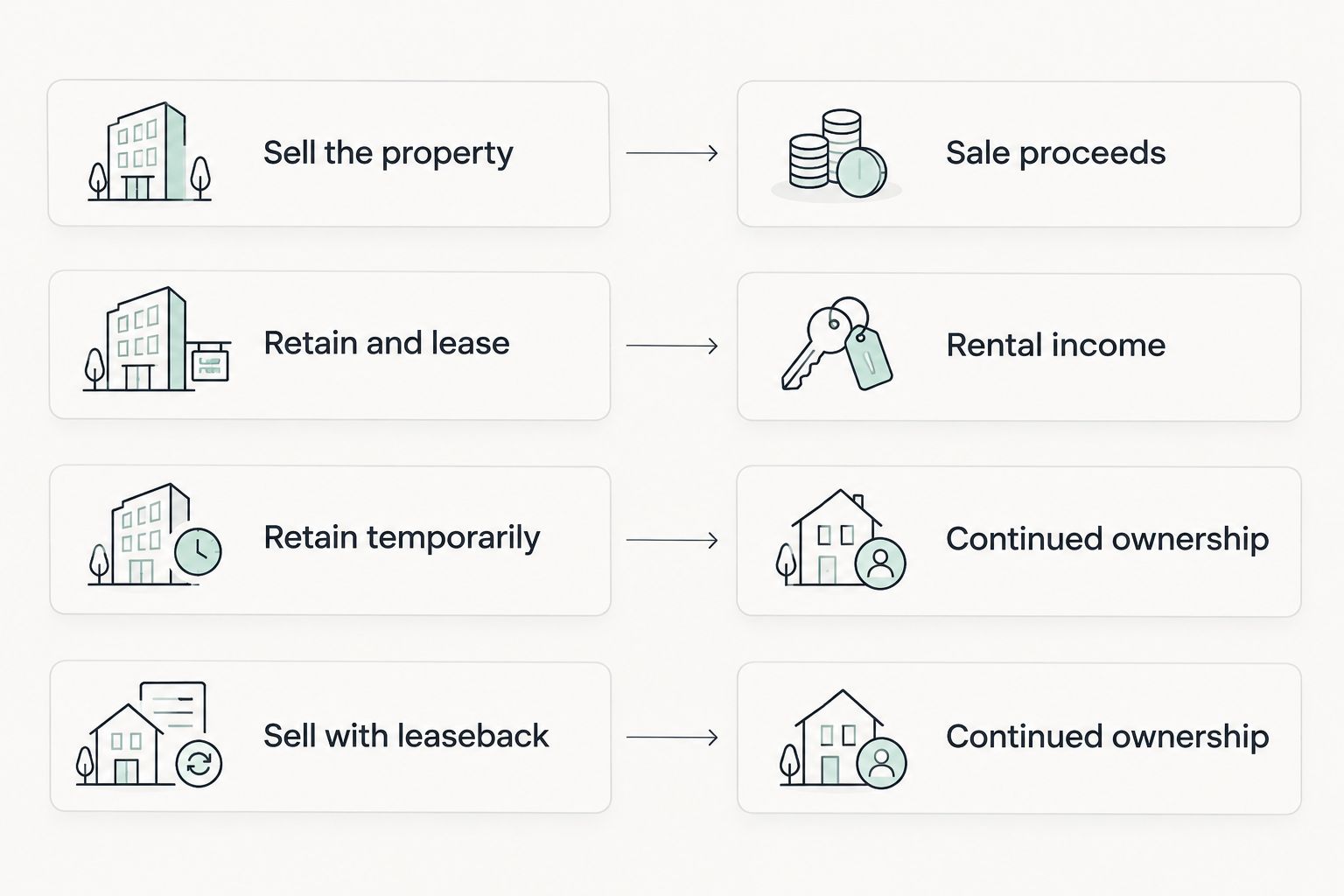
A sale with a leaseback deserves particular care when retirement also involves selling your business. The property buyer, business buyer, and landlord-tenant documents must fit together. Do not assume a future business buyer will accept occupancy terms negotiated before that buyer becomes involved.
Choose the right kind of valuation help
Start with your own document review to identify gaps. Then select professional help according to the decision you need to make, rather than treating every estimate as interchangeable.
| Approach | Best for | Main benefit | Key limitation |
|---|---|---|---|
| Owner-prepared worksheet | Organizing retirement goals and records | Clarifies assumptions before professional review | Does not independently establish market value |
| Broker market analysis | Planning a sale or lease | Connects market evidence to listing strategy | Is not a formal appraisal |
| Independent appraisal | Situations requiring a formal valuation assignment | Addresses a defined purpose, scope, and valuation date | Does not replace transaction representation or retirement planning |
| Tax and financial review | Evaluating proceeds and retirement consequences | Connects property choices to your wider financial position | Does not establish buyer demand or negotiate a transaction |
Common mistakes retiring owners make
Treating an asking amount as retirement cash
An estimate of market value does not account for every deduction from your proceeds. Keep property value, estimated sale proceeds, and spendable retirement funds on separate lines. Ask your advisers to explain the differences before you commit to a plan.
Keeping the building without accepting the landlord role
Leasing your former business property changes your role; it does not remove responsibility. Review tenant selection, repairs, insurance, accounting, and management before deciding that rental income is the simpler route.
Letting the business transition dictate undocumented terms
A handshake arrangement with your business or a successor leaves important occupancy questions unsettled. Document possession, rent obligations, repairs, and the intended handover. Have an attorney review the arrangement before presenting it to a property buyer.
Spending on improvements before testing buyer needs
Do not assume every improvement will return its cost at sale. Separate safety or compliance concerns from cosmetic preferences, then ask which work addresses a documented buyer objection. Obtain specialist advice where condition or permitted use remains unresolved.
FAQ
What is commercial valuation for retiring owners?
Commercial valuation for retiring owners assesses property value to support a retirement-related sale or leasing decision. It should distinguish market value from sale proceeds, ongoing rental cash flow, and business value.
Should I sell or lease my commercial property when I retire?
Choose selling when leaving ownership fits your plan; choose leasing only if retaining ownership and its responsibilities fits your plan. Compare proceeds, ongoing cash flow, capital needs, taxes, and management work with your advisers.
Do I need an appraisal before listing my Inland Empire property?
An appraisal is not a universal prerequisite to discussing a listing strategy with a broker. Obtain one when your lender, transaction, legal circumstances, or advisers require a formal valuation assignment.
Does my business income determine my building’s value?
Business income does not by itself establish the building’s value. Separate the operating business from the real estate, then evaluate property income, occupancy, condition, and relevant market evidence.
Can I sell my building and keep operating there?
A sale with a leaseback is a structure for selling a property while remaining as a tenant. It requires a willing buyer and agreed lease terms, and it leaves your business with continuing occupancy obligations.
What records should I prepare for a 2026 commercial valuation?
Prepare current leases and amendments, income and expense records, loan information, ownership documents, and repair records. Identify any differences between the documents and actual occupancy or collections before relying on an estimate.
Who should help me value a property before retirement?
Use a commercial broker for sale or leasing strategy, an appraiser for a formal valuation assignment, and tax and financial advisers for retirement consequences. An attorney should address ownership, contract, and legal questions.
One last thing
Decide what you want to stop doing before deciding what you want to receive. If your 2026 retirement goal is freedom from repairs, collections, and tenant decisions, a rental-income projection alone cannot answer whether keeping the property makes sense.
Bring that goal, your documents, and your unresolved questions to Javierbrown. The useful starting point is a comparison of selling and leasing—not an asking amount detached from your retirement plan.