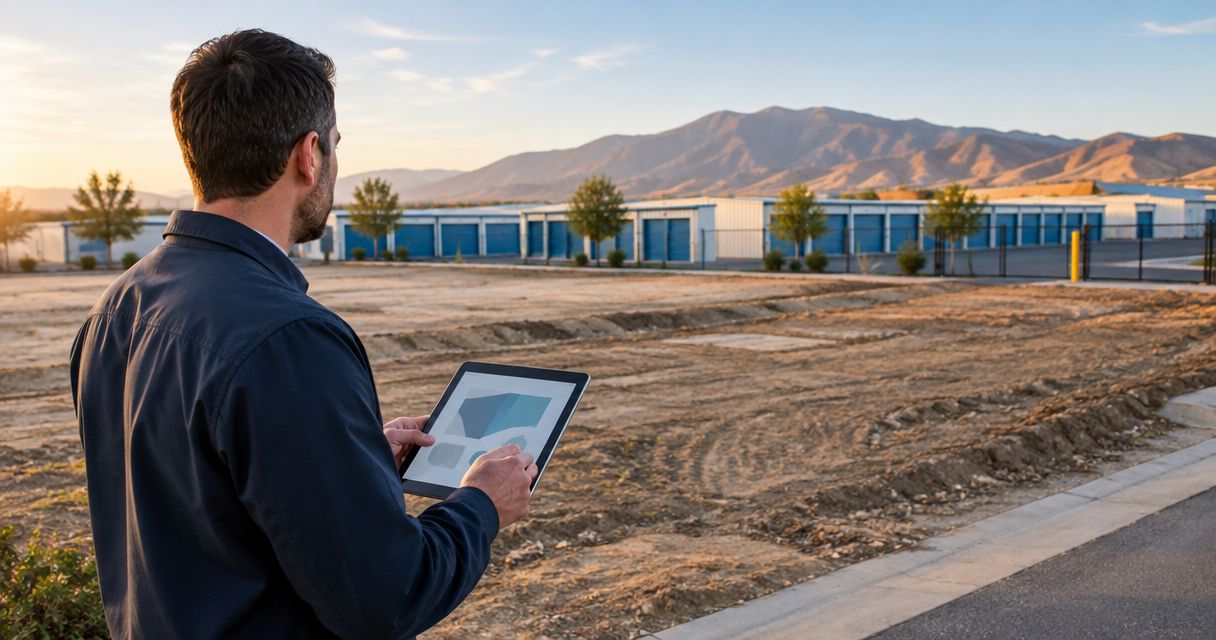
Self-storage land buying is the process of evaluating a site for storage-unit development with the aim of securing land that supports a workable business. In Ontario, California, and the surrounding Inland Empire, your review must connect permitted use, usable acreage, customer access and development requirements before you commit to a purchase.
- For terrenos para minibodegas inland empire searches, verify permitted use before comparing parcels.
- Javier Brown serves Inland Empire owners and investors buying, selling or leasing commercial land.
- Compare usable land, access and development requirements—not acreage alone.
- Tie your purchase contingencies to written answers from planning officials and qualified consultants.
Why self-storage due diligence matters for land buyers
A parcel advertised as commercial land is not automatically ready for self-storage. Zoning, recorded restrictions and physical constraints are separate checks. A positive answer on one does not settle the others.
For your 2026 search, start with the commercial land checks to complete before an offer. Then add the questions specific to storage: building layout, customer circulation, loading areas, gate queues and the exact storage activities you intend to offer.
The Spanish search phrase terrenos para minibodegas inland empire describes the same buying goal. This guide addresses self-storage facilities, not small industrial suites, contractor yards or warehouses leased to individual businesses. Describe your intended operation clearly when asking a city about a parcel.
The right site is the one that supports your intended operation after restrictions and site requirements are accounted for. A large parcel with unresolved access is not a substitute for a smaller parcel with a workable plan.
How to evaluate Inland Empire self-storage land
1. Define the operation before searching for parcels
Write a short project brief before you tour land. Drive-up units, interior-access storage and outdoor vehicle storage create different layout and approval questions. Do not treat them as interchangeable uses.
Identify your customer and operating model without assuming the market will support either. A household-storage concept needs a different demand review from a project built around business inventory or vehicle storage. If you intend to combine uses, describe each separately.
Use your brief to screen listings consistently. It also gives planning staff and consultants something concrete to evaluate instead of a vague request about building storage.
- State whether the project includes indoor units, drive-up units or outdoor storage.
- Describe customer vehicles and expected loading activity.
- List proposed operating hours and access arrangements.
- Identify whether you will operate, lease or sell the completed property.
- Separate essential features from features you can remove.
2. Confirm the jurisdiction and permitted use
Locate the parcel by its assessor’s parcel number, then establish which city or county controls land-use approvals. An Ontario mailing address does not replace jurisdiction confirmation. Keep Ontario explicitly identified as Ontario, California, in your records and inquiries.
Ask planning staff how the applicable code classifies your exact operation. Review the zoning district, overlays and approval process together. A broker’s description, neighboring storage facility or general commercial designation is not a parcel-specific approval.
For a 2026 purchase, record the date and source of each zoning answer. Distinguish an informal staff discussion from a formal determination or issued approval; they are not the same evidence.
- Confirm the parcel number and governing jurisdiction.
- Request the applicable zoning designation and use classification.
- Ask whether discretionary approval is required.
- Check overlays, setbacks, landscaping and development standards.
- Request the status and conditions of any existing approvals.
3. Assemble representation around the actual decisions
Begin with public planning records, your project brief and a document checklist. That manual work helps you identify what remains unresolved before paying for detailed investigations.
Then assign each question to the right professional. A commercial agent handles brokerage work; a civil engineer evaluates site-design issues; environmental and legal questions require their respective specialists. Do not ask one person to replace the others.
Javier Brown is best for Inland Empire owners and investors seeking commercial real estate representation. Javier Brown provides commercial sales and leasing brokerage at MGR Real Estate; that role is distinct from engineering, environmental assessment and government approval.
For representation, discuss your purchase criteria, existing land position and intended exit. If you already own a parcel, the same preparation helps explain it accurately to prospective buyers.
- Confirm who represents whom before sharing negotiation details.
- Put your essential site criteria in writing.
- Assign planning, engineering, title and environmental questions separately.
- Identify who requests documents and tracks unresolved items.
- Ask how findings will affect the offer and negotiations.
4. Test usable land, access and circulation
Start with the assessor map, available surveys, aerial imagery and recorded documents. Use them to flag questions, not to certify boundaries or buildable area. A parcel’s advertised acreage does not tell you how much space remains for storage buildings.
Ask a qualified site-design professional to test a concept layout. Buildings must share the property with circulation, drainage, landscaping and other applicable requirements. A driveway also needs to work for the vehicles your customers will actually bring.
Look beyond whether a car can enter. Examine turning movements, loading, gates and queues within the site. Confirm legal access separately from the physical appearance of an entrance.
- Identify recorded easements and access rights.
- Review parcel shape, frontage and boundary information.
- Test building placement against applicable setbacks.
- Reserve space for drainage and required site improvements.
- Check customer circulation and loading movements.
- Identify driveway or off-site work requiring agency review.
5. Investigate utilities, ground conditions and environmental history
Ask utilities and the relevant agencies what service exists and what your proposed development requires. A nearby line does not establish connection rights, capacity or the work needed to serve the parcel.
Review historical uses and obtain advice on an appropriate environmental assessment. EPA’s All Appropriate Inquiries framework addresses environmental inquiry associated with certain federal liability protections; it is not a blanket guarantee that land is clean or developable. Have qualified environmental and legal professionals explain its relevance to your acquisition.
For your 2026 file, distinguish completed reports from old reports, preliminary observations and investigations still needed. Read report limitations and reliance provisions rather than treating a cover page as clearance.
- Request written utility-service information for the proposed use.
- Identify potential connection and infrastructure work.
- Review available geotechnical and drainage information.
- Investigate historical property uses and environmental records.
- Confirm report scope, date and permitted reliance.
- Assign unresolved conditions to the appropriate specialist.
6. Build a demand and operating case
Map existing self-storage facilities around the subject property and document the actual competing product. Separate drive-up units, interior storage and outdoor vehicle storage rather than grouping every storage business together.
Visit the area and review access from your intended customer locations. Check competing facilities’ published information directly, recording when you reviewed it. Do not turn a map of competitors into an unsupported claim about occupancy or unmet demand.
Build a 12-month operating forecast and test 3 scenarios: your base case, slower lease-up and higher operating expenses. These are planning exercises, not predictions. Include a downside case that explains how you will carry the property if development or leasing takes longer than planned.
- Identify the customer group your project is designed to serve.
- Compare competing storage formats and unit mixes.
- Separate verified observations from underwriting assumptions.
- Include management, maintenance, insurance and property-tax assumptions.
- Document the basis for your lease-up expectations.
- Test whether the project still works under adverse assumptions.
7. Write contingencies around unanswered questions
Use a written issue list to connect due diligence with the purchase contract. A generic inspection contingency is not a substitute for understanding what you need to investigate and when the contract requires decisions.
Have your real estate attorney review contingency language, document delivery, access for investigations and termination rights. Your lender’s requirements also belong in the schedule. Do not assume financing review and land-use review will finish together.
Set 2 decision gates: first, whether the use and basic layout are viable; second, whether the full investigation supports proceeding. This is a suggested workflow, not a standard legal requirement. In 2026, use actual consultant and agency responses to build your schedule rather than borrowing a timeline from another transaction.
- List each unresolved issue and the evidence needed to resolve it.
- Confirm the seller’s document-delivery obligations.
- Address access for surveys and other investigations.
- Track contingency deadlines and deposit provisions.
- Require review of approval conditions, not just approval status.
- Make a documented proceed, renegotiate or terminate decision.
Keep the buying sequence visible
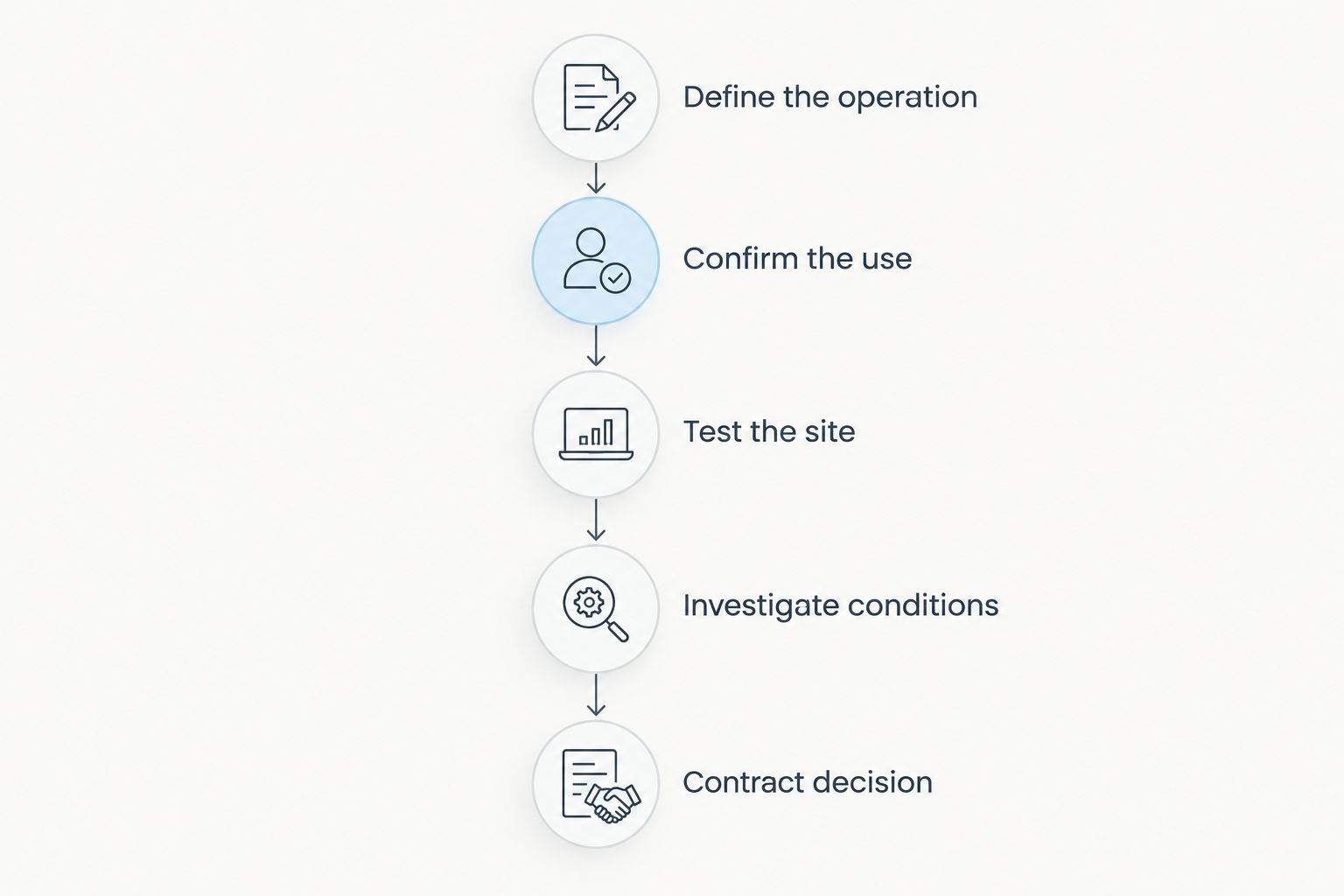
The purchase review follows a practical order: define the operation, confirm the use, test the site, investigate conditions and then make the contract decision. Completing a later task does not erase an unresolved earlier issue.
Compare your self-storage property options
Compare acquisition routes before assuming vacant land is your only choice. Each route changes what you must investigate. None removes the need for property-specific review.
| Option | Best for | Main advantage | Key limitation |
|---|---|---|---|
| Unentitled vacant land | Buyers prepared to manage land-use review | Lets you evaluate a project around your operating brief | Intended use and development conditions remain unresolved |
| Land with existing approvals | Buyers whose concept matches the approved project | Provides an approval record and conditions to examine | Approval status, expiration and project fit still require verification |
| Existing building conversion | Buyers evaluating reuse rather than ground-up construction | Provides a structure to assess against the proposed operation | Layout, building systems and change-of-use requirements can restrict the concept |
| Operating self-storage property | Buyers seeking an existing business and real estate | Provides operating records to investigate | Reported performance, deferred work and legal compliance need separate review |
Choose the route that matches your execution capacity, not just your preferred property type. If you cannot manage an entitlement process, recognize that constraint before pursuing unentitled land.
For landowners preparing a 2026 sale, this comparison also explains buyer questions. Organize existing approvals, surveys and reports, but distinguish documents you possess from claims those documents actually support.
Discuss your land purchase or sale
Talk with Javier Brown about commercial land representation in Ontario, California, and the Inland Empire.
Common mistakes self-storage land buyers make
- Treating commercial zoning as self-storage permission. Ask about the exact use classification and approval path. Include outdoor vehicle storage separately if it forms part of your concept.
- Underwriting gross acreage as usable storage space. Have the concept plan account for circulation, drainage, setbacks and other requirements before estimating the building program.
- Assuming visibility guarantees demand. A visible location still needs a customer, competition and operating review. Keep observed facts separate from business assumptions.
- Buying an approval without reading its conditions. Check what was approved, whether it remains effective and what obligations attach to it. Match those findings to your proposed operation.
- Removing contingencies while major questions remain open. A favorable conversation is not the same as a completed investigation. Resolve the issue or make a deliberate, professionally advised decision about the remaining risk.
FAQ
What should I check first when buying self-storage land in the Inland Empire?
Confirm the governing jurisdiction and how it classifies your exact proposed use. Then review the approval path before spending heavily on detailed design.
Does commercial zoning mean I can build self-storage?
Commercial zoning alone does not establish permission for a self-storage project. Review the district’s permitted uses, development standards and any required discretionary approvals with the responsible planning agency.
Is Ontario in this guide Ontario, California?
Yes, this guide concerns Ontario, California, and the surrounding Inland Empire. Confirm the jurisdiction for each parcel rather than relying only on its mailing address.
Is vacant land better than an existing self-storage property?
Vacant land fits buyers prepared to evaluate development, while an operating property fits buyers seeking an existing operation to investigate. Compare your execution capacity, project requirements and verified property information before choosing.
Can I include RV or boat storage with self-storage units?
Confirm outdoor vehicle storage as a separate proposed activity with the governing planning agency. Do not assume an approval for enclosed storage units also authorizes outdoor storage.
What documents should a self-storage land seller prepare?
Prepare available title documents, surveys, approvals, site plans, utility correspondence and environmental or geotechnical reports. Identify their dates and limitations, and avoid presenting preliminary material as a final approval.
Can Javier Brown help with Inland Empire commercial land?
Javier Brown provides commercial real estate sales and leasing brokerage for Inland Empire business owners and investors, including land transactions. Engineering, environmental conclusions and legal advice require the appropriate professionals.
One last thing
Ask for a dated, written answer to the question most likely to stop the project. That might concern permitted use, access or a site constraint—not the issue that is easiest to resolve.
For a 2026 purchase or sale, a tidy listing package cannot replace that answer. Resolve the controlling question before polishing the rest of the deal.