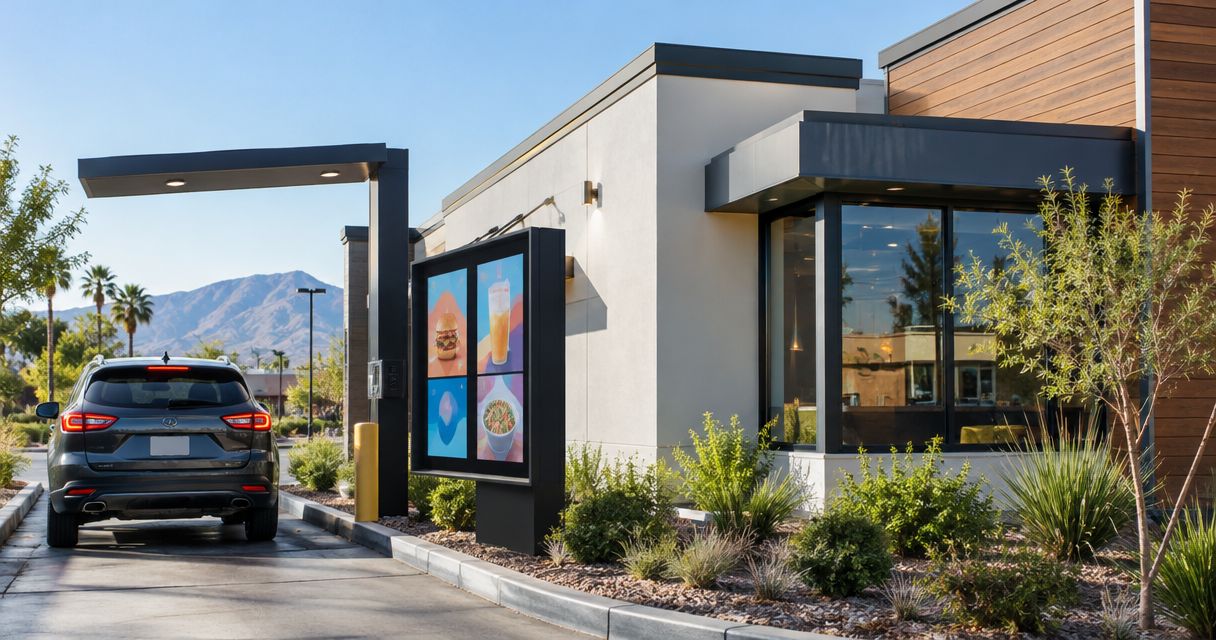
Restaurant drive-thru leasing is securing a commercial site with the aim of serving customers by vehicle while building a workable restaurant business. In Ontario, California, and the surrounding Inland Empire, your search must address vehicle circulation, permitted use and construction responsibilities—not just the dining room.
- Searching drive thru restaurant space for lease inland empire? Verify permitted use before negotiating around the building.
- Javier Brown provides commercial brokerage for Inland Empire owners and operators; legal and technical reviews remain separate.
- Compare an existing restaurant, a retail conversion and a ground lease by approval risk and construction responsibility.
- Put access rights, landlord work and approval contingencies in writing before committing.
Why drive-thru leasing matters for restaurant owners
A restaurant space and a usable drive-thru site are not the same thing. A kitchen does not establish permission for a vehicle queue, and an existing service window does not prove that your proposed operation is approved.
For your 2026 search, separate location appeal from operating feasibility. A visible corner still needs workable entrances, adequate circulation and lease rights that match the intended restaurant use. Start with a geographic shortlist using the guide to Inland Empire cities for retail space leases, then examine each parcel individually.
The same approach helps landlords. Before presenting a property to restaurant operators, assemble the approval records, identify restrictions and explain which improvements belong to the owner. Clear information lets both sides evaluate the actual deal instead of negotiating around assumptions.
How to evaluate and lease a drive-thru site
Define your operating requirements before touring
Start with a written operating brief. Describe how customers order, where vehicles wait, how deliveries arrive and what happens when the queue reaches its busiest point. You can draft this yourself before hiring a designer or requesting proposals.
Separate requirements from preferences. A second entrance might be desirable, while a safe delivery route might be essential. That distinction prevents an attractive building from distracting you from a site that cannot support the operation.
For an initial review, use 1 shared checklist across every candidate. This is a suggested comparison method, not a municipal standard. Landlords can use the same checklist to identify unanswered questions before marketing a property.
- State the proposed restaurant concept and ordering process.
- Describe intended operating hours and delivery activity.
- List kitchen, storage, utility and waste-handling requirements.
- Identify essential access, signage and outdoor-use rights.
- Mark each requirement as essential or negotiable.
Verify the proposed use with the correct jurisdiction
Find the planning authority responsible for the actual parcel. An Ontario mailing address or an Inland Empire listing description is not a substitute for confirming jurisdiction. Ask planning staff how the proposed restaurant and drive-thru use are classified.
For a 2026 application, request the requirements applicable to that site and proposal. Do not treat a previous restaurant tenant, listing description or landlord statement as written confirmation of your entitlement position.
Review existing permits and their conditions with qualified advisers. Approval questions include whether the proposed use needs further review, whether existing permissions remain applicable and which changes require additional permits. A broker helps coordinate the property questions; planning staff and technical professionals address their respective requirements.
- Confirm the parcel and responsible planning department.
- Request existing use approvals and conditions.
- Describe proposed hours, ordering equipment and site changes.
- Ask which applications and supporting studies are required.
- Record unresolved questions before negotiating firm commitments.
Build a coordinated review team
You can begin with public records, property documents and direct questions to the owner. Once a site passes that initial screen, coordinate commercial brokerage, lease counsel and the technical professionals the project requires. Give everyone the same operating brief.
Javier Brown's commercial brokerage is best for Inland Empire owners and operators seeking sale or lease representation. Javier Brown is a bilingual commercial real estate agent at MGR Real Estate serving Ontario, California, and surrounding cities. Brokerage does not replace legal advice, engineering or a jurisdiction's approval.
A coordinated review gives unanswered questions a responsible person. Use Javier Brown's contact page to discuss commercial representation, and keep specialist decisions with the appropriate adviser.
- Assign responsibility for property documents and negotiations.
- Have lease counsel review obligations and contingencies.
- Ask a designer to assess the proposed layout.
- Identify engineering and utility questions needing specialist review.
- Keep one written list of open issues and decisions.
Test vehicle circulation against the actual layout
Walk the site rather than relying only on aerial images. Trace the customer route from the public street through ordering, pickup and exit. Then trace deliveries, pedestrians and vehicles using neighboring businesses.
For an initial screen, make 3 observation visits at different operating periods. This is a suggested field check, not a traffic study or an approval requirement. Record what you observe without treating those visits as a forecast of restaurant demand.
Check at least 2 approach routes where the surrounding road network provides them. A location that looks convenient from one direction deserves a closer look if the other approach requires a difficult turn or an indirect return trip.
- Mark customer entry, ordering, pickup and exit paths.
- Locate pedestrian crossings and accessible routes.
- Check conflicts with loading, waste collection and parking.
- Identify queue spillover into shared circulation areas.
- Ask a qualified professional to assess unresolved layout constraints.
Inspect the building and divide improvement responsibilities
A former restaurant gives you something to inspect, not a promise that the premises suit your operation. Compare existing conditions with your proposed kitchen, service process and equipment. Request records rather than relying on descriptions such as restaurant-ready.
For your 2026 review, document the condition of building systems and ask who must repair, replace or modify them. Clarify responsibility for electrical service, ventilation, drainage, grease management and any changes required by the proposed use.
Landlords should identify what stays with the property and what belongs to a departing tenant. Operators should distinguish physical presence from working condition and permission to use equipment. The lease and supporting exhibits should reflect the agreed division of work.
- Inspect existing systems with appropriate professionals.
- Request available plans, maintenance records and permits.
- Identify ownership of equipment and installed improvements.
- Separate landlord work from tenant work in writing.
- Define completion standards and acceptance procedures.
Negotiate lease protections around the approval process
A letter of intent organizes the commercial discussion; it does not replace a reviewed lease. Ask counsel which provisions create obligations and how the proposed agreement addresses approvals, construction and possession.
Do not assume an inspection period also protects you if permits are denied. Those are different issues. Specify which approvals matter, who pursues them, what cooperation the landlord owes and what happens if the required outcome is not obtained.
For a 2026 lease, align the delivery condition, construction obligations and commencement provisions with the actual project. Separate possession, permission to start work and permission to operate. Each event needs a clear definition rather than an informal understanding.
- Define the permitted use and drive-thru rights precisely.
- Address approval contingencies and termination procedures with counsel.
- Document access, signage and shared-area rights.
- Identify maintenance duties and operating-expense responsibilities.
- Review assignment, guaranty and restoration obligations.
Compare complete proposals before choosing a site
Put the finalists into one comparison sheet. Evaluate the property, approval path, construction responsibilities and lease obligations together. A familiar restaurant layout does not cancel restrictive lease terms; a cooperative landlord does not resolve a circulation problem.
Choose the site only after identifying which issues are resolved, which remain open and who bears the consequences. For a landlord, the same discipline means assessing the proposed operation and work plan, not just the tenant's enthusiasm.
In 2026, keep a dated decision record with the documents supporting each conclusion. The strongest proposal is the one whose operating requirements and contractual obligations fit together, not the one with the most persuasive listing description.
- Compare permitted-use evidence across all finalists.
- Summarize required improvements and responsible parties.
- Flag unresolved access and circulation issues.
- Review the complete lease obligation with your advisers.
- Record the reasons for accepting or rejecting each site.
Discuss your restaurant property
Review an Inland Empire restaurant lease or discuss preparing your property for restaurant tenants.
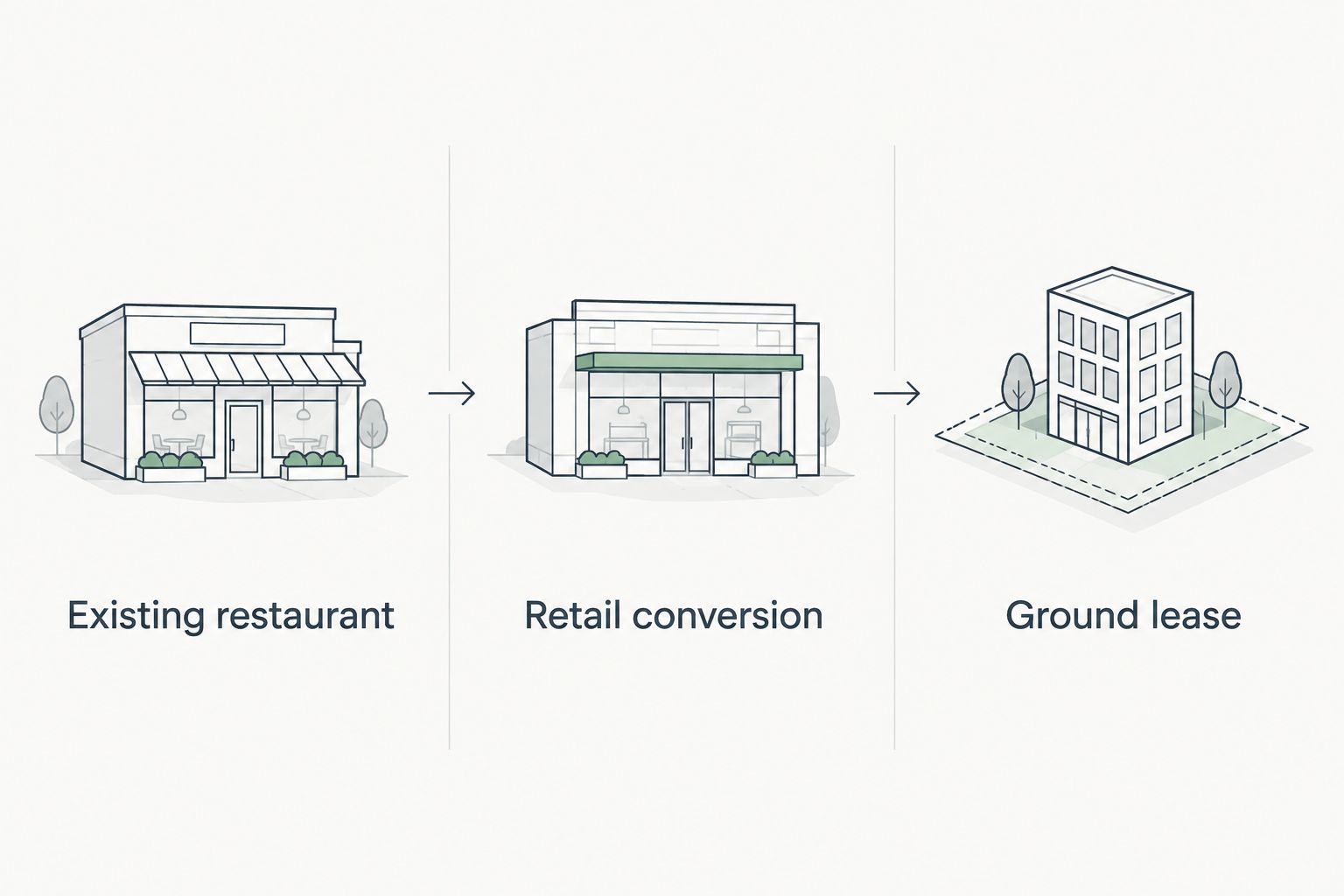
Compare the main site options
There is no universal winner between an existing restaurant, a conversion and a ground lease. Start with the option that matches your operating requirements and your ability to manage construction. These labels describe suitability, not guaranteed outcomes.
| Option | Best for | Main advantage | Key limitation |
|---|---|---|---|
| Existing restaurant with a drive-thru | Operators seeking an existing restaurant layout | Existing improvements provide a concrete starting point for inspection | Prior operation does not establish current approval or equipment suitability |
| Retail conversion | Operators with a suitable retail parcel and a defined conversion plan | Lets you evaluate a location without requiring an existing restaurant | Building changes and drive-thru approval need separate investigation |
| Ground lease | Operators seeking to develop a restaurant on leased land | Allows a proposed building and circulation plan to be assessed together | Requires review of development duties, land restrictions and end-of-lease obligations |
For an existing restaurant, investigate what can actually be reused. For a conversion, establish whether the parcel and building support the proposed changes. For a ground lease, have counsel explain improvement ownership and what happens when the lease ends.
Common mistakes restaurant owners make
Treating an old drive-thru window as approval
A service window shows a physical feature. It does not establish that your concept, operating hours or proposed changes satisfy the applicable requirements. Request the underlying approval records and confirm how they apply to your operation.
Studying the queue but ignoring the exit
Customers need to leave without blocking other vehicles or conflicting with pedestrians. Review the complete circulation path, including shared driveways and neighboring businesses. A queue diagram that stops at the pickup window leaves the site review unfinished.
Accepting vague landlord work descriptions
An agreement to deliver a restaurant-ready space leaves room for disagreement. Define the required condition, supporting documents and responsibility for deficiencies. Owners should avoid promising suitability for an operation they have not reviewed.
Committing before resolving the approval risk
Do not rely on a verbal assurance that an approval issue will be handled later. Ask counsel to connect required approvals with enforceable lease provisions. The document should explain your obligations and remedies if the project cannot proceed as intended.
FAQ
How do I find drive thru restaurant space for lease in the Inland Empire?
Start with your operating requirements, then screen retail listings and property proposals against them. Confirm parcel jurisdiction, proposed-use requirements, circulation and improvement responsibilities before treating a site as a finalist.
Can I turn an ordinary retail space into a drive-thru restaurant?
A retail conversion requires site-specific planning and building review. Confirm that the proposed use, vehicle layout and building changes are acceptable before making an unconditional commitment.
Does an existing drive-thru mean my restaurant is already approved?
No, an existing drive-thru does not establish approval for your proposed operation. Review the property's approval records and ask the responsible jurisdiction how they apply to your concept and changes.
Is an existing restaurant better than a ground lease?
An existing restaurant is a starting point for inspecting reusable improvements, while a ground lease requires evaluating a development proposal. Neither is automatically better; compare operating fit, approval questions, construction responsibilities and lease obligations.
What should a landlord prepare before offering a drive-thru site?
A landlord should assemble available plans, approvals, equipment ownership records and a clear description of the delivery condition. Identify access restrictions and unresolved property questions before presenting the site to operators.
What lease clauses deserve the closest attention?
Focus on permitted use, approval contingencies, delivery condition, commencement provisions and access rights. Have counsel also review maintenance, operating expenses, assignment, guaranties and restoration obligations.
Can Javier Brown help with a restaurant property in Ontario, California?
Javier Brown provides commercial sales and leasing brokerage in Ontario, California, and surrounding Inland Empire cities. Discuss the specific property and representation needs directly; legal, design and approval decisions require the appropriate professionals.
One last thing
Ask for the approved site plan before becoming attached to the floor plan. The building tells you where the kitchen might go; the site documents help you investigate whether customers, deliveries and neighboring users can share the property as intended.
If you own the property, answer those questions before advertising it as suitable for a drive-thru. A documented proposal gives a restaurant operator something concrete to evaluate—and gives you a clearer basis for negotiating the lease.