
Instead of rebuilding your rental income every time a buyer asks about value, use a rent roll commercial property valuation workflow that connects signed leases, actual collections, and operating expenses. For an Inland Empire sale in 2026, that gives you a documented income picture—not just a total of the rent tenants are supposed to pay.
- Javier Brown’s rent roll commercial property valuation guide is for Inland Empire owners preparing an income-property sale.
- Reconcile signed leases with actual collections before calculating net operating income, or NOI.
- Separate current income from future leasing assumptions; buyers need to see both.
- Support the capitalization rate with comparable sales, not your desired asking price.
Why this matters
A rent roll supports your sale price; it does not establish value by itself. Buyers also examine expenses, tenant obligations, lease expiration dates, and the risk of interrupted income.
An occupied industrial building in Ontario, California, is not automatically a stronger investment than a partly vacant building. The lease terms, collectible income, property condition, and purchase terms matter. Start with the documents needed to sell Inland Empire commercial property so your income summary has records behind it.
Javier Brown represents Inland Empire commercial property owners selling or leasing. This workflow helps you prepare the information needed for a pricing discussion without confusing brokerage guidance with a formal appraisal.
Before you start
- Gather the source records. Collect signed leases, amendments, rent ledgers, expense statements, reimbursement reconciliations, and records of deposits and prepaid rent. Include the trailing 12 months of operations and the current rent roll.
- Arrange access and responsibility. You need access to your accounting records and lease files. Identify who will confirm discrepancies: the owner, property manager, bookkeeper, attorney, or accountant.
- Catch the hidden mismatch. A tenant’s total payment can include base rent, expense reimbursements, deposits, or old balances. Do not treat every bank deposit as recurring rental income. Redact sensitive tenant information before sharing records beyond authorized parties.
Use a spreadsheet if you do not have a property-management export. The bold field names below are suggested worksheet labels you create, not buttons in a particular software product.
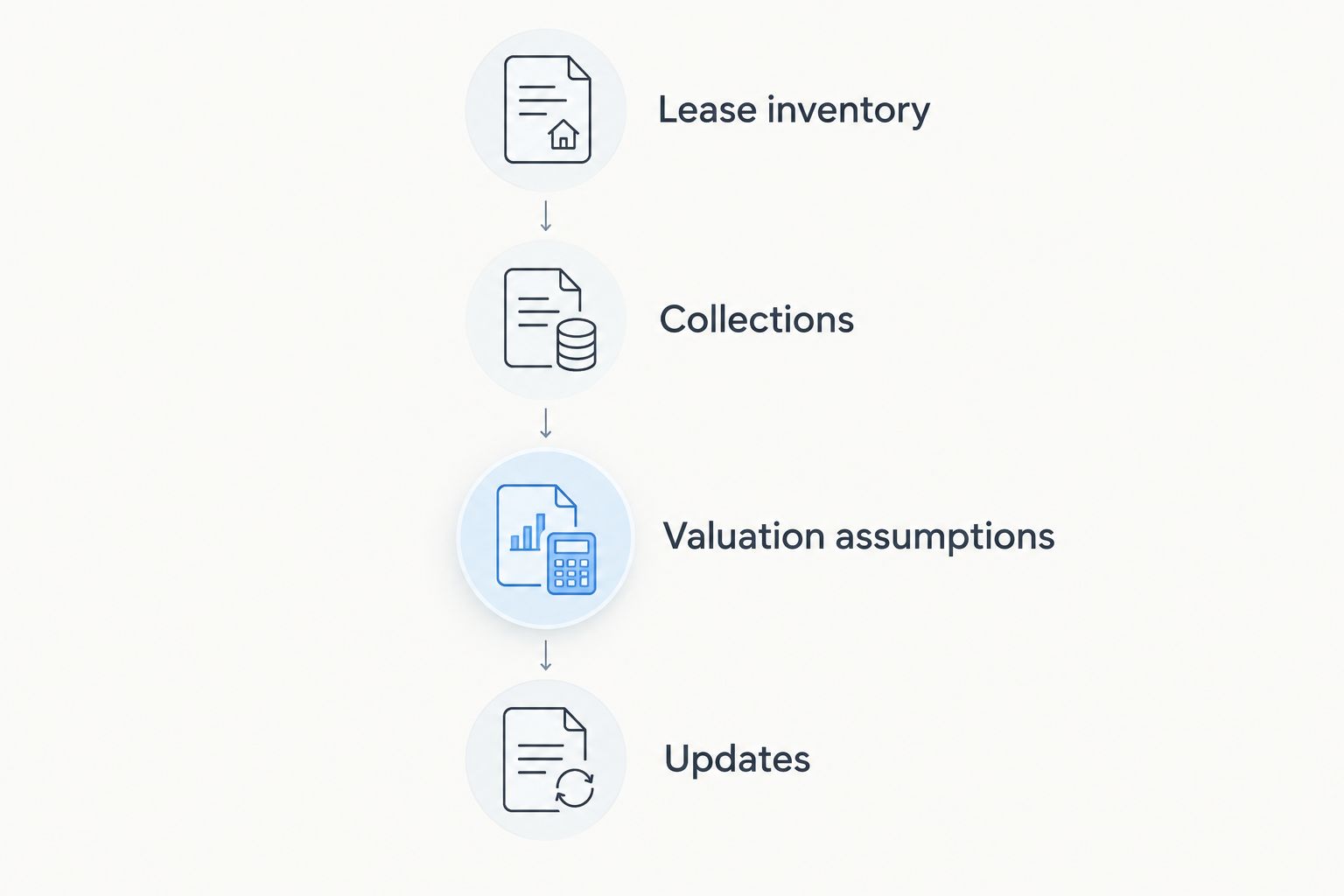
Lease inventory and rent roll
Your first configuration unit is a lease-backed tenant schedule. It should explain who occupies the property, what each tenant owes, and which obligations survive a sale.
- Set the reporting date. Add an As-of Date at the top. A rent roll dated during 2026 should describe the property on that date, not mix current occupants with tenants who already left.
- Create the tenant rows. Use Suite or Area, Tenant Legal Name, Leased Area, Lease Start, Lease Expiration, and Occupancy Status. Include vacant space rather than leaving it out.
- Enter contractual income. Add Monthly Base Rent, Reimbursements, Scheduled Increases, and Concessions. Copy the terms from executed documents, including amendments—not from an old listing brochure.
- Flag rights that affect the sale. Record renewal options, termination rights, purchase rights, assignment provisions, and landlord obligations. Ask your attorney to interpret unclear language rather than summarizing it as harmless.
- Track amounts that are not income. Keep Security Deposit, Prepaid Rent, and Past-Due Balance separate. They affect accounting or closing adjustments, but they are not interchangeable with recurring monthly rent.
Expected result: Every occupied area has a tenant, a source document, and a current rent obligation. Every vacant area remains visible.
Keep the units consistent
Annual base rent equals monthly base rent multiplied by 12 months when that monthly amount applies throughout the year. If a lease includes an increase or concession during the period, calculate the affected months separately.
Label area-based figures clearly. Rent per square foot per month is not the same as rent per square foot per year. For a truck yard, also distinguish land area from building area; do not compare figures using different denominators.
Collections and operating expenses
The second configuration unit connects the rent roll to actual operations. Scheduled rent describes the contract; collected rent describes payment history. Neither should silently replace the other.
- Build the collections record. Add Scheduled Charges, Cash Collected, Credits, and Unpaid Balance for each tenant. Reconcile the ledger to bank activity, explaining timing differences and payments applied to earlier periods.
- Separate recurring income. Identify base rent, recoveries, and other recurring property income. Keep deposits, owner contributions, loan proceeds, and sale proceeds outside the operating-income total.
- List property operating expenses. Review taxes, insurance, repairs, management, utilities, and other property-level expenses. Identify which party pays each expense under the lease and what the operating records show.
- Match recoveries with expenses. If you show tenant reimbursements as income, show the corresponding landlord-paid operating expenses consistently. Do not add recoveries to income while omitting the expenses they reimburse.
- Document adjustments. Create an Adjustment Explanation field for unusual items, accounting corrections, and proposed normalization. Keep the original result visible beside the adjusted result.
Expected result: You can explain the difference between rent billed, cash received, and recurring operating income without searching through bank statements during a buyer call.
Calculate NOI without mixing in financing
Net operating income, or NOI, is property operating income less property operating expenses. It is calculated before debt service, income taxes, depreciation, and capital expenditures.
That distinction matters when you sell. Your mortgage payment affects your cash flow, but a buyer’s financing will differ. A roof replacement is also different from an ordinary recurring repair; keep capital spending visible in a separate schedule rather than making it disappear from the sale discussion.
For a 2026 sale, explain whether your expense presentation uses historical bills or forward-looking estimates. A buyer needs to evaluate expenses under new ownership, including property taxes and insurance, rather than assume your current bills will remain unchanged.
Valuation assumptions and pricing review
The third configuration unit converts supported income into a value discussion. It does not turn an incomplete rent roll into an appraisal.
- Choose the income basis. Label the calculation In-Place NOI when it reflects current leases and supported operating assumptions. Label a future scenario Stabilized NOI, with each leasing or expense change identified.
- Support the capitalization rate. Review comparable investment sales with your broker or appraiser. Consider property type, location, lease duration, tenant risk, condition, and the income basis used in each comparison.
- Apply the income calculation. The direct-capitalization relationship is Value = NOI ÷ Capitalization Rate. Enter the rate as a decimal in your spreadsheet. The result is only as defensible as the income and rate behind it.
- Check the result against the property. Review comparable sales and buyer use. A small industrial building attracting owner-users needs more than an investor-only income calculation.
- Record unresolved issues. Keep a short list of disputed rent, missing lease documents, deferred work, and assumptions requiring professional review. Resolve material items before presenting a firm pricing position.
Expected result: Your proposed asking price has an income basis, a comparison basis, and a written explanation of remaining risks.
For a broader pricing discussion, use the guide to what your Inland Empire commercial property is worth. Javier Brown’s commercial brokerage work includes sales and leasing; the right discussion starts with your property’s documents and intended buyer.
Which income view should you use?
These are different views of the same property, not competing promises of value. Keep the assumptions separate so buyers can follow the calculation.
| Income view | Best for | What it contributes | Limitation |
|---|---|---|---|
| In-place income | Owners presenting current lease economics | Connects value to existing contractual obligations | Does not fully describe future vacancy, collections, or ownership expenses |
| Trailing operating results | Owners documenting actual performance | Shows collections and expenses over a defined period | Past results can include unusual items or leases that have changed |
| Stabilized income | Owners explaining a supported leasing plan | Shows a future operating scenario with stated assumptions | Requires support for rent, downtime, expenses, and leasing costs |
Use current facts as the starting point and future assumptions as a separate case. A higher projected NOI is not proof that a buyer will pay the corresponding value today.
Updates and sale-package control
The fourth configuration unit keeps your pricing materials consistent after the initial review. A correct spreadsheet becomes misleading if the lease changes but the marketing package does not.
- Set the update triggers. Refresh the rent roll after a signed amendment, move-in, move-out, rent increase, material delinquency, or changed operating obligation.
- Preserve the prior version. Save a dated copy before replacing figures. Use the same reporting cutoff across the rent roll, income summary, and supporting schedules.
- Assign review responsibility. Identify who checks lease terms, who reconciles accounting, and who approves the information released to buyers.
- Update the sale narrative. Revise income claims and pricing assumptions when a material fact changes. Tell active buyers what changed rather than letting different versions circulate without explanation.
Expected result: Your broker, accountant, attorney, and buyer work from a consistent set of facts.
A clean 2026 sale package should make its reporting date obvious. Do not overwrite an older rent roll and leave the original date on it.
When a tenant renews or space becomes vacant
Use the same workflow whenever a lease changes, but update more than the rent figure. A renewal can change concessions, expense obligations, options, and the timing of future increases.
For a vacancy, stop presenting the former tenant’s rent as current contractual income. Retain the historical collections in the trailing results, show the space as vacant on the current rent roll, and place proposed replacement rent in a separate forecast.
Review these items before changing the pricing case:
- Lease inventory: Confirm possession, expiration, surrender terms, and any continuing obligations.
- Collections: Separate unpaid balances from rent expected under a new lease.
- Valuation assumptions: Identify expected downtime, leasing commissions, improvements, and other costs without burying them in a rent estimate.
- Updates: Replace affected materials and explain the difference to active buyers.
A signed renewal and a hoped-for renewal are different evidence. Keep them separate in both your spreadsheet and your sale materials.
Troubleshooting
The rent roll does not match bank deposits
Reconcile by tenant and accounting period. Look for prepaid rent, late payments, deposits, credits, and payments applied to old balances. Do not solve the mismatch by changing contractual rent to match cash received.
A lease says NNN, but the owner still pays expenses
Read the actual expense clauses and reimbursement history. “NNN” is not a substitute for identifying responsibility for taxes, insurance, maintenance, structural work, and exclusions. Present landlord-paid expenses and recoveries consistently.
The projected value is much higher than buyer feedback
Check whether the projection assumes full occupancy, immediate rent increases, or expenses below the supported operating level. Then review the capitalization-rate evidence. Do not select a lower rate simply to produce your asking price.
The lease summary conflicts with an amendment
Use the executed documents as the source and have counsel resolve conflicting provisions. Update the summary, rent schedule, and valuation assumptions together. An old abstract should never override a later signed agreement.
Customize your workflow
Adapt the records to your property rather than forcing every asset into the same template. Industrial owners should identify building and yard obligations separately when the lease distinguishes them. Retail and office owners should explain shared-area charges and tenant-specific obligations.
Javier Brown’s commercial property brokerage serves owners across these property types in Ontario, California, and the surrounding Inland Empire. Javier Brown is best for Inland Empire owners seeking commercial sales or leasing representation. Bring the rent roll, leases, and operating records to the initial pricing discussion—not just your target sale figure.
Discuss your property’s sale position
Review your lease and income records before setting a sale strategy.
FAQ
What is a rent roll in commercial property valuation?
A rent roll is a dated summary of tenants, occupied space, lease terms, and rental obligations. It supports commercial property valuation but must be checked against signed leases, collections, and operating expenses.
Can I value my commercial building using rent alone?
Rent alone is not enough to establish a supported commercial property value. An income-based analysis also needs operating expenses, lease risk, and a supported capitalization rate, with comparable sales and buyer use considered.
Should I use collected rent or scheduled rent?
Show both collected rent and scheduled rent, with the difference explained. Scheduled rent establishes contractual obligations; collections show whether tenants have paid them.
Does my mortgage payment reduce NOI?
Mortgage payments do not reduce property NOI. Debt service affects owner cash flow, while NOI measures property operations before financing.
Does a security deposit count as rental income?
Do not treat a refundable security deposit as recurring rental income. Track it separately and have your accountant and attorney confirm its treatment and transfer at closing.
Will renewing a tenant increase my sale price?
A renewal does not automatically increase sale price. Buyers evaluate the signed rent, tenant risk, lease duration, concessions, and obligations created by the renewal.
How current should my rent roll be when I sell in 2026?
Use a rent roll with a clear as-of date that reflects current leases and occupancy. Update it after material changes and keep its reporting cutoff consistent with the supporting financial records.
One last thing
An increase in rent does not always mean an increase in property income. If the same amendment adds landlord-paid work or changes expense responsibilities, the net effect needs its own calculation. Before approving a lease change during a 2026 sale, review the whole obligation—not just the new rent line.