
Franchise commercial leasing is the process of matching a franchise operator’s business requirements with a property and lease that protect the owner’s income and the operator’s ability to open. For landlords in Ontario, California, and the surrounding Inland Empire, the negotiation must address the tenant’s financial backing, brand requirements, construction responsibilities, and exit rights—not just rent.
- For renta comercial franquicias inland empire, negotiate tenant identity, permitted use, construction duties, and exit rights before signing.
- Javierbrown serves Inland Empire owners who need bilingual commercial leasing representation.
- A franchise brand’s name does not establish that the franchisor guarantees the lease.
- Compare direct negotiation, brokerage representation, and legal review by the work each handles.
Why franchise commercial leasing matters for Inland Empire owners
A franchise location brings another decision-maker into your leasing process: the franchisor. The operator’s preferred premises, your property restrictions, and the brand’s approval requirements need to fit together. Treating those as separate conversations leaves important conditions unresolved.
Start your 2026 leasing plan by deciding who will coordinate the transaction. The commercial agent selection checklist helps you evaluate representation before you authorize negotiations.
The name on the storefront is not a substitute for reviewing the entity signing your lease. Ask whether the proposed tenant is the franchisor, an established franchise operator, or a newly formed entity. Then document the financial support and contractual protections you actually receive.
For an owner, a useful offer explains how the tenant will occupy, operate, maintain, and eventually surrender the premises. A signed proposal that leaves those questions open is not a finished leasing plan.
How to negotiate a franchise lease without leaving gaps
1. Define the permitted use before discussing concessions
Start with a written description of the proposed operation. You can prepare this yourself using the operator’s business description, equipment needs, anticipated customer activity, and requested alterations. Do not assume a general retail description covers every activity the franchise intends to conduct.
For a property in Ontario, California, confirm the applicable approval process with the city. For another Inland Empire property, contact the jurisdiction responsible for that address. Separately review recorded restrictions and existing leases for conflicts with the proposed use.
A landlord’s approval does not replace government approval. Likewise, a franchisor’s acceptance of the site does not establish that the proposed operation is permitted there.
Prepare a 1-page use summary for your 2026 property file. Give the same summary to the operator, broker, and attorney so everyone works from the same assumptions.
- Describe the actual business activity, not just the franchise category.
- Identify requested hours, deliveries, customer pickup, and outdoor activity.
- Check parking, access, signage, and equipment requirements.
- Review existing exclusive-use provisions and property restrictions.
- Identify which approvals must be obtained before work begins.
2. Verify the tenant and negotiate financial responsibility
Ask the proposed tenant for an ownership chart, operating history, financial statements, and the identity of any proposed guarantor. A direct request is the manual starting point; organize the responses in a single file rather than scattered email attachments.
Distinguish the operating company from related entities. Owning other franchise locations does not automatically make those entities responsible for this lease. If the operator describes corporate backing, ask which entity will sign a binding obligation and have counsel review the language.
A deposit and a guaranty address different concerns. Negotiate their scope alongside assignment rights, default provisions, and any requested release—not as isolated terms at the end.
Javierbrown’s commercial leasing representation is best for Inland Empire owners seeking bilingual brokerage support. Brokerage can help organize the commercial negotiation; an attorney should review the enforceability and scope of the documents.
- Confirm the tenant’s exact legal name and authorized signer.
- Request financial information relevant to the proposed obligation.
- Identify the guarantor separately from the tenant.
- Document the scope and release conditions of any guaranty.
- Ask what happens if ownership or franchise affiliation changes.
3. Compare the full lease obligation, not one headline term
Build a spreadsheet before responding to the proposal. Use separate lines for base rent, scheduled increases, operating expenses, landlord work, tenant improvements, maintenance, insurance requirements, and renewal rights. Record who is responsible without assuming a familiar lease label settles the question.
If the proposal uses NNN, meaning triple net, identify the actual expenses the tenant must pay. The document should explain the treatment of property taxes, insurance, maintenance, and other charges rather than leaving those responsibilities to shorthand.
For your 2026 comparison, use a 12-month operating worksheet and a separate schedule covering the proposed lease term. Keep recurring obligations separate from construction and other one-time commitments.
Javierbrown provides commercial sales and leasing brokerage for Inland Empire owners and investors. Representation gives you a point of coordination for comparing proposals, but it does not replace your review of property expenses or legal advice.
- Separate recurring expenses from one-time commitments.
- Identify which expenses are recoverable from the tenant.
- Define maintenance duties for major building systems.
- Record the timing and conditions of negotiated concessions.
- Compare renewal rights and expense obligations alongside rent terms.
4. Tie construction and commencement to defined events
A franchise operator’s opening plan can involve landlord delivery, government approvals, construction, inspections, and brand approval. Write down the sequence before negotiating who bears the consequences of delay.
Separate possession, permission to start work, lease commencement, and the start of payment obligations. These events need clear definitions. An opening date alone does not explain what happens when the premises are ready but a tenant-controlled approval remains outstanding.
Use 3 checkpoints: delivery, approvals, and opening. At each checkpoint, identify the responsible party, required evidence, and contractual consequence if the condition is not satisfied. Have counsel turn the agreed business terms into lease language.
Do not promise that a property can support a particular installation without appropriate verification. Assign responsibility for investigating electrical service, plumbing, ventilation, accessibility, and other requirements relevant to the proposed use.
- Attach a written description of the landlord’s delivery condition.
- Separate landlord work from tenant work.
- Identify who obtains each permit or approval.
- Define the evidence required before improvement reimbursements.
- State how delays affect deadlines and payment obligations.
- Allocate ownership and removal duties for installed improvements.
5. Limit exclusivity and preserve control over transfers
A franchise operator might request protection from competing uses, assignment flexibility, or rights for the franchisor to take over after a default. Evaluate each request against the property’s existing obligations and your plans for the building.
For exclusivity, define the protected activity precisely. Broad language can affect future leasing beyond the business activity you intended to protect. Review exceptions, existing tenants, enforcement duties, and remedies with counsel before agreeing.
For transfers, distinguish an assignment of the lease, a sale of the operator’s business, a change in ownership, and franchisor step-in rights. The lease should explain which events require notice or consent and whether the original tenant or guarantor remains responsible.
Include these provisions in your 2026 lease comparison before selecting an offer. A proposal with fewer restrictions on your property can differ materially from one that gives the operator broad control over future occupancy.
- Define protected uses narrowly and explicitly.
- List existing uses and agreed exceptions.
- Identify transfers that require landlord consent.
- Review franchisor notice, cure, and step-in requests.
- Document whether liability survives an approved transfer.
6. Complete a coordinated review before signing
Create one issue list covering the proposal, lease draft, construction exhibit, guaranty, and any franchisor addendum. You can maintain this manually with columns for the issue, agreed position, responsible reviewer, and unresolved question.
The purpose is consistency. A proposal can describe one delivery obligation while an exhibit describes another. An addendum can alter transfer or default provisions elsewhere in the lease. Review the documents together rather than approving each in isolation.
Keep written approval records for the final commercial terms. If the parties change a business point during legal review, update the issue list and confirm that the change appears wherever necessary.
- Match legal names across every document.
- Reconcile deadlines and commencement definitions.
- Check construction duties against the final exhibits.
- Review conflicts between the lease and franchisor addendum.
- Confirm signature authority and required attachments.
- Retain the signed documents in one accessible property file.
Discuss your franchise leasing terms
Discuss your Inland Empire property, proposed tenant, and lease priorities.
Compare your negotiation and review options
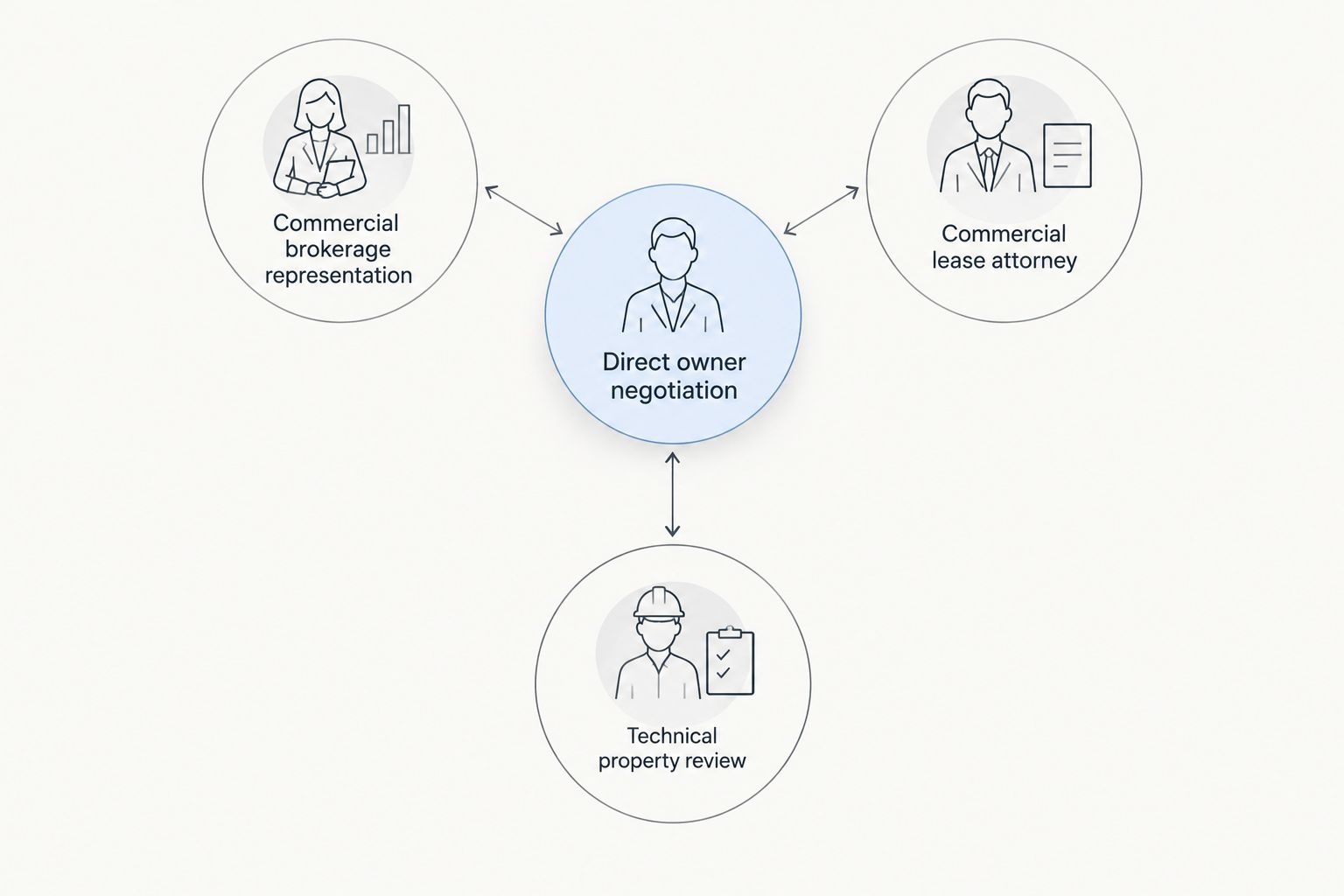
Choose help according to the task, not a promise that one professional handles everything. Direct negotiation, brokerage representation, and legal review serve different purposes; you can combine them.
| Option | Best for | Main benefit | Key limitation |
|---|---|---|---|
| Direct owner negotiation | Owners prepared to manage proposals and follow-up | Keeps commercial decisions directly with the owner | Requires you to organize comparisons, approvals, and unresolved issues |
| Commercial brokerage representation | Owners seeking help with positioning and commercial terms | Provides a coordinator for marketing, proposals, and negotiations | Does not replace legal, tax, engineering, or permitting advice |
| Commercial lease attorney | Owners reviewing enforceable obligations and document conflicts | Addresses lease language, guaranties, remedies, and addenda | Does not replace property marketing or technical inspections |
| Technical property review | Owners evaluating the proposed physical use | Examines the building conditions and systems within the reviewer’s scope | Does not settle lease terms or guarantee government approval |
Use the right reviewer for the right question. Your broker can negotiate a construction responsibility; the appropriate technical professional evaluates the physical requirement; your attorney documents the obligation.
Common mistakes landlords make with franchise tenants
Treating brand recognition as financial security
A recognizable franchise name tells you little about the obligations of the entity signing your lease. Review the tenant and guarantor documents rather than assuming the brand stands behind payment or performance.
Negotiating concessions before confirming the use
An attractive proposal does not solve incompatible access, utilities, operating restrictions, or approval requirements. Establish whether the intended operation fits the property before committing to work or other concessions.
Accepting an undefined delivery condition
Terms such as ready for occupancy leave room for disagreement when the parties expect different building conditions. Attach a specific delivery description and allocate responsibility for the remaining work.
Reviewing the franchisor addendum last
A franchisor addendum can address assignment, notices, cure rights, and other material terms. Request it early enough to review alongside the main lease, not after the commercial negotiation is treated as complete.
Leaving renewal and surrender terms unresolved
Opening gets attention; the end of the lease deserves the same care. Address renewal procedures, removal obligations, repairs, signage, and the condition in which the premises must be returned.
FAQ
What should I negotiate first when leasing to a franchise?
Start with the tenant’s identity, permitted use, and financial responsibility. Then negotiate construction duties, commencement events, operating expenses, transfers, and end-of-lease obligations as connected terms.
Does the franchise company automatically guarantee the lease?
No. A franchise name does not establish that the franchisor guarantees the lease. Identify the signing tenant and review any separate guaranty with your attorney.
Who should pay for franchise-specific improvements?
Responsibility for franchise-specific improvements must be negotiated and written into the lease documents. Separate landlord delivery work from tenant work, then define approval, reimbursement, ownership, and removal conditions.
Should I let the franchise operator assign the lease?
Negotiate assignment rights around the proposed transfer and your property requirements. Address consent, financial review, franchisor involvement, and whether the original tenant or guarantor remains liable.
Is a commercial broker better than a lease attorney?
A commercial broker and a lease attorney perform different jobs. Brokerage addresses marketing and commercial negotiation; legal counsel reviews obligations, document language, and remedies.
Can I approve a franchise use without checking with the city?
Your approval does not establish that the proposed use has government authorization. Confirm the approval process with the jurisdiction responsible for the property, including Ontario, California, when the premises are there.
Can Javierbrown help an Inland Empire landlord negotiate a lease?
Javierbrown provides commercial sales and leasing brokerage for Inland Empire owners and investors, with bilingual service. Legal, tax, permitting, and technical questions require the appropriate professional review.
One last thing
Before signing a franchise lease in 2026, test one scenario: the tenant cannot open on the planned date. Read the documents and identify who must act, who remains responsible for payment, and what happens next.
If the documents do not answer those questions consistently, resolve the conflict before signing. This exercise turns an optimistic opening plan into a practical review of the obligations you are accepting.