
Instead of chasing loan documents after signing an offer, use the SBA loan commercial property purchase process to connect lender review, property checks, contract deadlines, and funding before you commit. For an owner-user buying in Ontario, California, or the surrounding Inland Empire, the sequence is: confirm eligibility, structure the offer, clear underwriting conditions, then close.
- The SBA loan commercial property purchase process starts with business eligibility and owner-occupancy, not an accepted offer.
- Javier Brown is best for Inland Empire owner-users seeking commercial real estate representation, not loan approval.
- Compare SBA 7(a) and 504 financing before writing financing contingencies into your purchase agreement.
- Keep lender conditions, property inspections, and contract deadlines in one shared closing checklist.
Why this matters
An accepted offer does not establish that your business qualifies for financing or that the building works for your operation. Your lender reviews repayment ability and program eligibility; your property investigation addresses condition, permitted use, access, and other transaction risks.
Javier Brown is best for Inland Empire owner-users seeking commercial real estate representation, not loan approval. Start with Javier Brown for property representation, and keep credit decisions with the lender.
For a seller reviewing an SBA-financed offer in 2026, the same distinction matters. A buyer's enthusiasm is not financing evidence; ask what the lender has reviewed, which conditions remain, and whether the proposed contract schedule supports those conditions.
Before you start
- People and access: Identify the operating business, authorized decision-makers, lender contact, commercial agent, and escrow contact. For SBA 504 financing, include a Certified Development Company, or CDC, which handles the SBA-backed portion of that structure.
- Documents: Assemble business financial statements, tax returns requested by the lender, ownership information, debt schedules, and documentation of the proposed equity contribution. Obtain property information and existing leases from the seller through the transaction team.
- The gotcha: SBA real estate financing serves eligible operating businesses, not passive investment purchases. Confirm occupancy eligibility before pursuing a partly leased building; a tenant's future departure does not establish that your planned occupancy meets program requirements.
This is a purchase workflow, not a commitment to lend. Have the lender confirm current 2026 requirements for your business, ownership structure, property, and chosen program before you sign binding obligations.
Financing and occupancy review
Choose the loan structure before the property deadline
- Describe the complete project. Tell the lender whether you are buying only a building or also financing eligible improvements, equipment, or working capital. Separate the business's operational needs from the seller's preferred transaction terms.
- Compare SBA 7(a) and SBA 504. Ask the lender to explain eligibility, required contribution, collateral, guarantees, repayment structure, and closing conditions. Do not choose a program from an advertised payment alone.
- Verify owner-occupancy. SBA guidance generally requires the operating business to occupy at least 51% of an existing building. New construction generally starts with at least 60% occupancy and carries additional future-occupancy requirements; have the lender document the applicable rules.
- Match the loan structure to the ownership structure. If a separate entity will own the real estate and lease it to the operating business, disclose that arrangement immediately. Have the lender and your advisers confirm the required relationship, lease terms, and documentation.
| Financing option | Best for | Main advantage | Main limitation |
|---|---|---|---|
| SBA 7(a) | Eligible owner-users whose project combines real estate with other permitted business purposes | Can accommodate eligible real estate and working-capital needs within one program | Business eligibility, repayment ability, and lender conditions still control approval |
| SBA 504 | Eligible owner-users focused on long-term fixed assets | Designed for qualifying fixed-asset projects through a lender-and-CDC structure | Does not finance working capital and requires coordination among financing parties |
SBA's published 7(a), 504, and owner-occupancy guidance provides the program framework for this 2026 checklist. SBA 7(a) real estate financing can have a maturity of up to 25 years; that maximum is not a promise about your approved term or repayment structure.
Expected result: You have a lender-reviewed financing direction, a documented occupancy plan, and a list of unresolved eligibility questions. You are not treating a preliminary conversation as final approval.
Offer terms and transaction control
Connect the letter of intent to the purchase agreement
- Write the business requirements first. Identify the intended use, required possession, occupancy area, access needs, and improvements essential to opening. An industrial building that suits storage does not automatically permit outdoor truck parking or your particular operation.
- Use the letter of intent to surface conflicts. Address financing, investigation access, seller documents, existing tenancies, and the proposed closing schedule. Have counsel review which provisions are binding; a document called an LOI is not automatically nonbinding in every respect.
- Put protections in the purchase agreement. Have the transaction team address financing and investigation contingencies, deposit treatment, access, document delivery, possession, and extensions. Do not assume an LOI provision survives unless the signed contract carries it forward.
- Build a shared deadline register. Use these suggested tracker labels: Contract deadline, Lender condition, Responsible party, Evidence received, and Next action. These are organizational labels, not required fields in a lender's software.
- Get the seller's documents moving immediately. Request applicable leases and amendments, property operating information, available plans, and relevant reports. Mark missing items as open conditions rather than treating silence as confirmation.
A seller accepting an SBA-financed offer should use the same register. It separates buyer-controlled paperwork from third-party reports and seller-controlled access, making extension requests easier to evaluate on their actual cause.
Expected result: The signed agreement and financing plan use compatible deadlines, and every open item has an owner. For the broader transaction sequence, use the industrial sales offer-to-closing workflow.
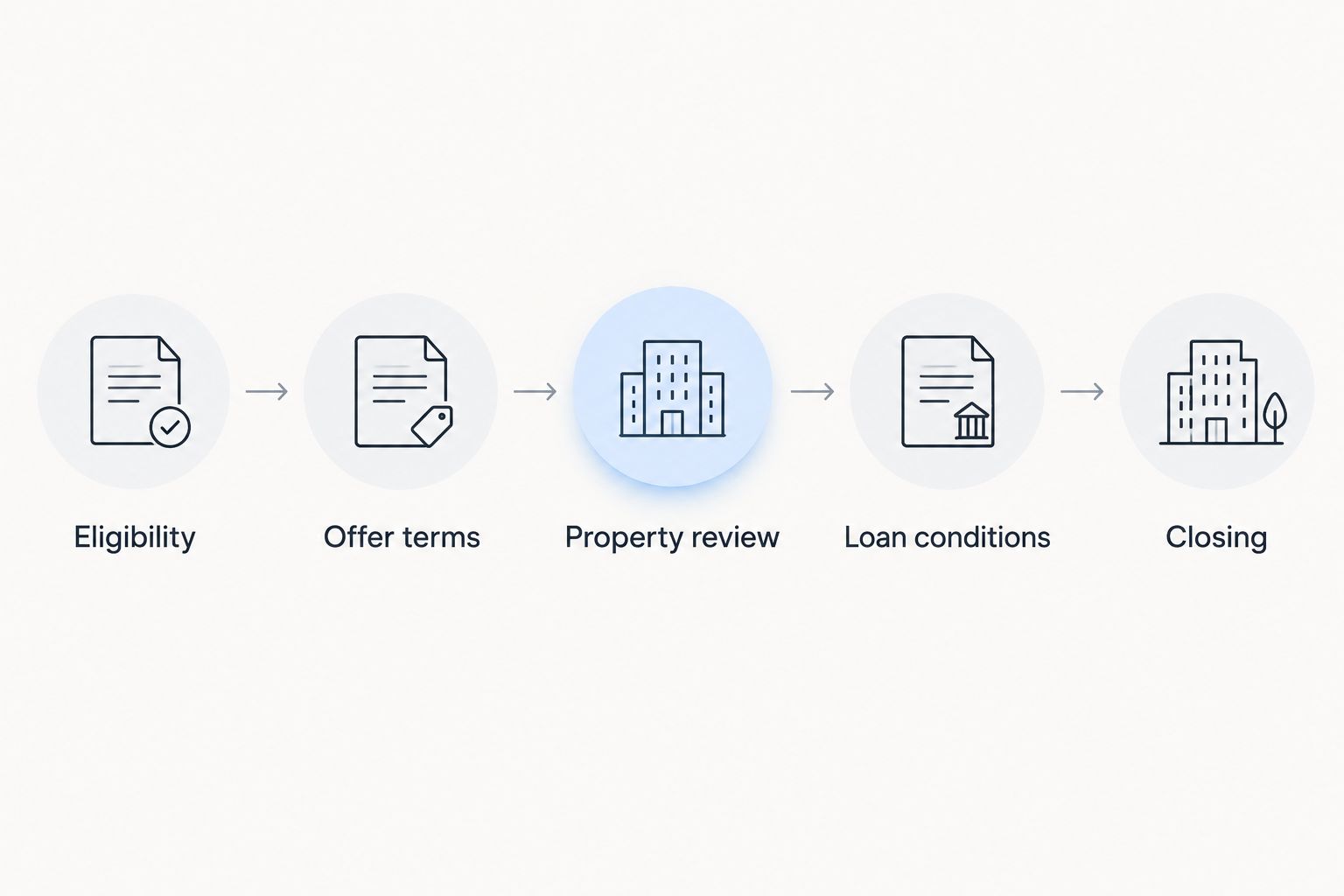
The workflow follows a simple order: Eligibility, Offer terms, Property review, Loan conditions, and Closing. A later step does not replace an unresolved earlier check.
Property review and underwriting
Clear the building and the borrower together
- Follow the lender's document request. Submit complete, consistent financial records through the lender's approved channel. Explain unusual entries and ownership changes rather than leaving underwriting to reconcile conflicting documents.
- Confirm the intended use with the correct authority. For Ontario, California, verify the property's applicable zoning and approval requirements with the city. For another Inland Empire location, identify the actual jurisdiction; a mailing address does not settle land-use authority.
- Arrange inspections and lender-required reports. Coordinate building investigations, appraisal, and environmental review with the lender's requirements and the contract. Do not order a substitute report independently and assume the lender will accept it.
- Review leases and possession. Compare lease terms, amendments, occupancy rights, and delivery obligations against your business's move-in plan. If the seller promises vacant possession, require the transaction documents to address how and when that occurs.
- Turn every issue into a decision. For an unacceptable condition, identify the needed evidence, repair agreement, contract amendment, or other resolution. Obtain written lender direction when a property issue affects financing.
An appraisal is not a building inspection, a zoning approval, or an environmental clearance. Each answers a different question. Keep the reports separate in your checklist so one completed item does not falsely clear the others.
For a 2026 purchase, maintain one current document set and clearly mark superseded versions. An amended lease or revised ownership schedule should reach the lender and relevant advisers, not remain buried in an email thread.
Expected result: Your lender has the requested borrower and property information, and you have resolved operational suitability separately from loan eligibility. Any remaining issue has a named decision-maker and a contract deadline.
Funding and possession
Turn conditional approval into a controlled closing
- Request the remaining conditions in writing. Separate credit approval from document preparation, funding authorization, and closing. Ask who must satisfy each condition and what evidence establishes completion.
- Reconcile the transaction documents. Check the approved borrowing entity, ownership entity, property description, required insurance, and applicable lease documents. Resolve inconsistencies through the lender, escrow, and legal advisers before signing.
- Confirm the funds-to-close instructions securely. Independently verify wiring instructions using a trusted contact method already established with escrow. Do not rely on an unexpected email changing account details.
- Coordinate the financing parties. For SBA 504 financing, have the lender and CDC explain the acquisition-funding sequence, any interim financing, and the later debenture funding process. These are not automatically the same event.
- Confirm closing and possession separately. Obtain the required confirmation of funding and recording through escrow, then follow the contract's possession provisions. Arrange keys, access credentials, utilities, and tenant communications as applicable.
Do not schedule business occupancy from a verbal funding estimate. Use confirmed transaction milestones and the possession language in the signed agreement.
Expected result: The lender and escrow confirm the required closing events, and your business receives possession under the contract. Preserve the final loan, title, escrow, and occupancy documents together.
When the property or occupancy plan changes
A revised property plan needs a revised lender review. Switching buildings, adding construction, changing the owning entity, or discovering a continuing tenant can affect underwriting and contract terms.
- Stop using the old approval assumptions. Give the lender the updated property facts, occupancy plan, and project scope.
- Request a revised condition list. Confirm which reports, financial information, and approvals must be updated or replaced.
- Reset the contract schedule in writing. Have the transaction team address amendments and extensions before existing deadlines expire.
- Update possession and business planning. Recheck tenant rights, improvement requirements, and the date your operation can lawfully begin.
This variant is especially relevant when an owner-user considers a leased building. Existing rental income does not override SBA owner-occupancy requirements. Confirm that the actual lease and possession arrangements support the proposed financing.
Troubleshooting
The lender has issued preliminary approval, but closing stalls
Ask for the outstanding conditions and identify whether each belongs to underwriting, documentation, property review, or escrow. Stop describing the file as ready to fund until the lender confirms that status.
The tenant occupies space your business needs
Review the lease and any enforceable termination or surrender documents with counsel. Do not base occupancy eligibility on a seller's informal assurance that the tenant will leave.
The appraisal does not support the agreed transaction
Ask the lender how the appraisal affects the proposed financing, then review your contractual options with the transaction team. Do not assume the seller must renegotiate or that your financing contingency protects every deposit circumstance.
Environmental review raises an unresolved concern
Follow the lender's required review process and use qualified environmental professionals. Coordinate any further investigation with property access rights and contract deadlines rather than assuming a prior report ends the issue.
The loan schedule extends beyond a contract deadline
Request an extension before the deadline and document the reason, remaining conditions, and proposed resolution. A lender delay does not automatically extend the purchase agreement.
Customize your workflow
For your 2026 purchase, add a separate workstream for anything essential to operating the business: tenant improvements, permits, equipment installation, access, or utility needs. Financing approval alone does not confirm readiness to open.
If you are selling, build a matching seller checklist for document delivery, inspections, lease questions, and possession. Javier Brown's commercial real estate representation covers Inland Empire buyers and sellers; the lender remains responsible for loan approval.
Discuss your property transaction
Talk through an Inland Empire commercial purchase or sale and the property questions to resolve.
FAQ
What's the first step in buying commercial property with an SBA loan?
Start by having an SBA lender review your business eligibility, repayment ability, and planned owner-occupancy. Then structure the property offer around the financing and investigation requirements.
Is SBA 7(a) or SBA 504 better for buying a business building?
SBA 7(a) fits a broader range of eligible business purposes, while SBA 504 focuses on qualifying fixed assets. Compare the complete project, ownership structure, required contribution, and closing process with the lender and CDC where applicable.
Can I buy an Inland Empire rental property with an SBA loan?
SBA real estate financing is not designed for passive investment purchases. An eligible operating business must satisfy the applicable owner-occupancy and other program requirements.
How much of an existing building must my business occupy?
SBA guidance generally requires your operating business to occupy at least 51% of an existing building. Have the lender confirm how the rule applies to the property's space, leases, and ownership arrangement.
Does an SBA loan approval mean the property is approved for my business use?
No. Loan approval does not replace zoning verification, permit review, building investigations, or environmental review. Confirm the intended operation with the appropriate jurisdiction and qualified advisers.
Can I close before all lender conditions are finished?
The lender determines which conditions must be satisfied before funding. Do not waive contractual protections or promise a closing date based only on preliminary approval.
What should a seller check before accepting an SBA-financed offer?
A seller should check the buyer's financing status, unresolved conditions, investigation needs, and proposed deadlines. Ask what the lender has actually reviewed rather than treating a general qualification letter as final approval.
One last thing
The building can close before the business is ready to occupy it. Keep a separate permission-to-operate checklist alongside your closing checklist; ownership, financing, possession, and lawful use answer different questions.
Before removing contingencies, have the relevant decision-makers explain what remains unresolved in each category. That conversation is more useful than asking only whether the loan is approved.