
E-commerce warehouse leasing is renting industrial space to receive, store, pack, and ship online orders with the aim of keeping fulfillment dependable as your business changes. For your 2026 search in Ontario, California, and the surrounding Inland Empire, choose a building around inventory flow, carrier access, returns, and permitted use—not square footage alone.
- Warehouse lease ecommerce Inland Empire: choose permitted use and fulfillment fit before comparing lease proposals.
- Javierbrown provides commercial real estate brokerage for Inland Empire business owners and investors.
- Compare a dedicated warehouse, shared warehouse, and third-party logistics provider against your operating needs.
- Put loading access, improvements, repair duties, and possession conditions in writing before signing.
Why warehouse leasing matters for e-commerce businesses
An e-commerce warehouse needs to handle goods moving in both directions. Deliveries enter, orders leave, and returns come back for inspection, restocking, or disposal. A building that stores inventory comfortably can still create problems at the packing bench or loading door.
Javierbrown is best for Inland Empire business owners seeking local commercial real estate brokerage. Javierbrown serves business owners and investors buying, selling, or leasing commercial property, including industrial space.
Your warehouse decision also affects the landlord's approval process. Explain your operation clearly: what you store, how goods arrive, which activities happen inside, and whether customers visit. A clear operating description gives both parties something specific to evaluate.
For a 2026 search, build the property brief from your actual order records and inventory requirements. A listing description does not establish whether your business can operate there legally or efficiently.
How to choose an Inland Empire e-commerce warehouse
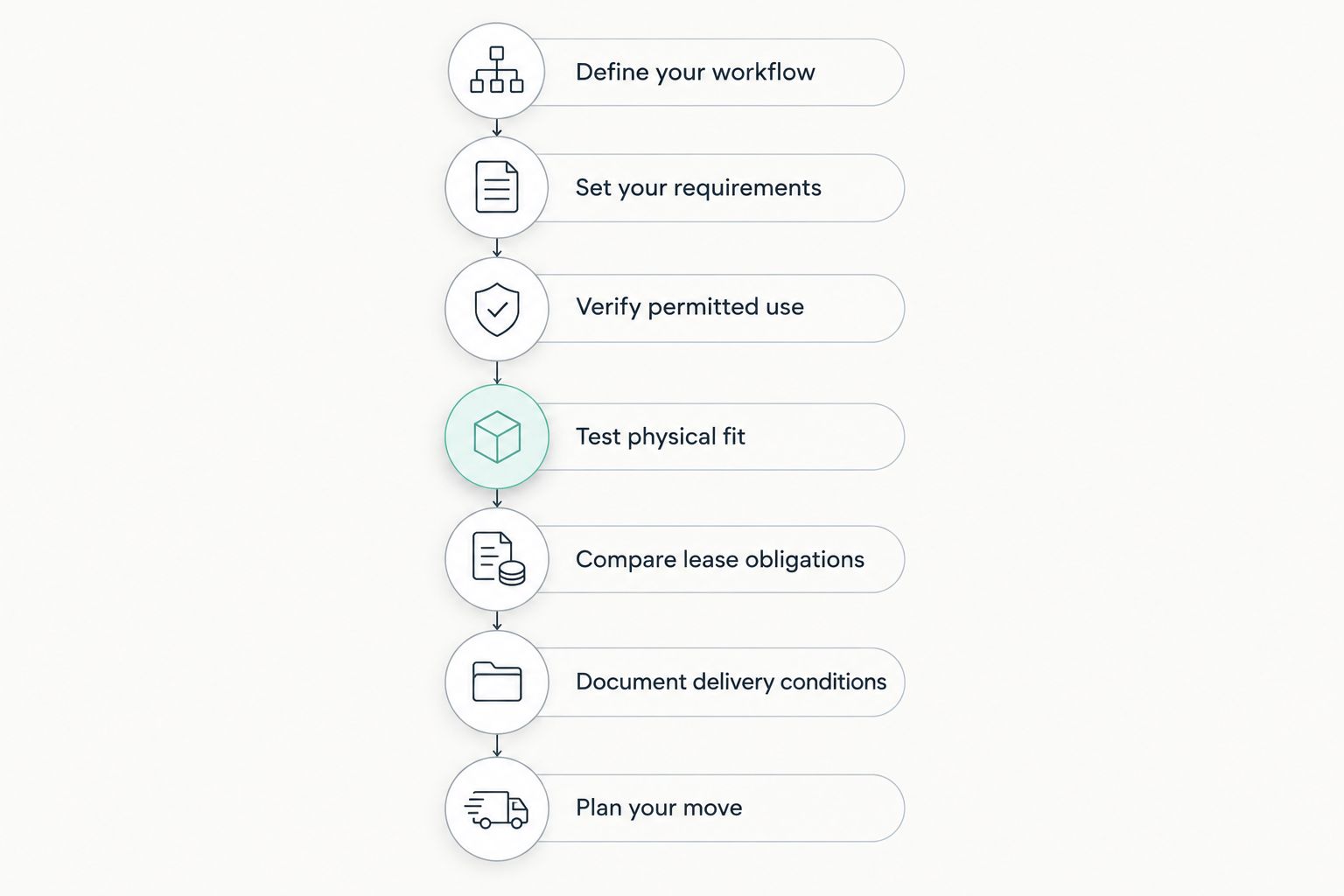
1. Define your workflow
Start with a spreadsheet and a simple floor sketch. Follow inventory from delivery through receiving, storage, picking, packing, shipping, and returns. Mark where goods wait between activities; those holding areas need space too.
Separate 3 operating zones: receiving, fulfillment, and returns. This is a planning framework, not a required building layout. Some operations combine activities, but your sketch should show how workers and goods move without blocking exits or loading areas.
Use your own records rather than an assumed industry average. Seasonal inventory, bulky packaging, and returned merchandise can change the space you need without changing your daily order count.
- List product dimensions and storage requirements.
- Record inbound delivery methods and shipment sizes.
- Identify packing benches, equipment, and supplies.
- Assign a place for returned or damaged goods.
- Mark pedestrian paths and equipment movement.
2. Set your requirements
Turn the workflow into a written property brief before scheduling tours. Divide requirements into must-haves and preferences. A necessary loading configuration belongs in the first group; a preferred office finish belongs in the second.
Build your 2026 shortlist around the operation you can document. If future growth is uncertain, identify what would trigger expansion rather than committing to an unsupported forecast.
Start the search yourself with listing information and direct questions. Javierbrown's commercial real estate brokerage offers a service-based route for business owners who want help with an industrial lease search; it does not replace your operational decisions or technical inspections.
For location research, use the best Inland Empire markets for logistics tenants guide as a starting point, then test each location against your actual routes.
- Separate essential features from optional upgrades.
- Identify the cities your operation can realistically serve from.
- Specify loading, storage, office, and parking needs.
- State your intended move date and lease flexibility needs.
- Prepare a plain-English description of your business.
3. Verify permitted use
Confirm the proposed operation with the relevant city or county and the landlord before treating a property as suitable. Zoning, existing approvals, building conditions, and lease restrictions are separate checks. An existing warehouse use does not establish approval for every storage or fulfillment activity.
Describe the operation accurately. Battery storage, aerosols, food products, assembly, customer pickup, and outdoor storage can raise different questions. Ask the appropriate agencies and qualified advisers what applies to your goods and activities.
Do not treat a landlord's verbal approval as a substitute for required government approvals. Likewise, a government approval does not override restrictions in the lease. Document both before committing to improvements or a move.
- Submit a written description of the intended use.
- Check zoning and applicable business approval requirements.
- Ask about fire protection and storage configuration requirements.
- Confirm whether customer pickup or outdoor storage is allowed.
- Identify approvals needed before occupancy or construction.
4. Test physical fit
Tour with your workflow sketch, equipment requirements, and delivery details. Walk the route from the street to the loading area, then from receiving to storage and packing. Measure critical openings rather than relying on photos.
Distinguish usable space from advertised area. Columns, offices, utility equipment, and circulation routes affect what fits. Have qualified professionals assess racking, electrical needs, fire protection, and any proposed alterations.
Carrier access deserves its own check. A parcel collection routine and a freight delivery routine place different demands on doors, staging, parking, and vehicle movement. Confirm access rights rather than assuming nearby pavement is included.
- Measure doors, interior obstructions, and relevant clearances.
- Check delivery vehicle access and loading arrangements.
- Locate electrical service, restrooms, and employee areas.
- Identify exclusive and shared parking or loading spaces.
- Test where outbound orders wait for collection.
5. Compare lease obligations
Request written proposals and place the terms side by side in a spreadsheet. For each 2026 lease comparison, separate the right to occupy the property from the responsibilities that come with it. Similar spaces can carry different maintenance and repair obligations.
A triple-net, or NNN, lease generally passes specified property expenses to the tenant in addition to base rent. The actual lease determines which expenses apply, how they are allocated, and what exclusions or limits exist. The label alone is not enough.
Compare 3 responsibility categories: operating expenses, repairs, and improvements. Ask a commercial real estate attorney to review the draft, especially personal guarantees, assignment restrictions, default provisions, and end-of-term duties.
- Identify expenses charged separately under the proposed lease.
- Clarify roof, structure, equipment, and system repair duties.
- Document who approves and completes proposed improvements.
- Review insurance, indemnity, and guarantee provisions.
- Examine renewal, assignment, sublease, and surrender terms.
6. Document delivery conditions
Write down the condition in which the landlord must deliver the space. Separate existing conditions from work promised before possession. A tour conversation is not a construction scope or an enforceable completion standard by itself.
Distinguish 2 milestones: possession and rent commencement. Your lease should explain when each occurs and how incomplete work, approvals, or other conditions affect them. Have counsel address the consequences rather than assuming a delay automatically changes your obligations.
Take dated photographs and keep inspection records. Define how equipment and systems will be evaluated, who handles defects, and which alterations must be removed when the lease ends.
- Describe the required delivery condition in writing.
- Attach agreed work and approval responsibilities.
- Clarify possession and rent commencement provisions.
- Record existing damage and equipment condition.
- Define restoration and removal duties at lease end.
7. Plan your move
Create a move plan before signing, then update it as approvals and delivery conditions become firm. Identify dependencies: racking cannot be used before required approvals, and inventory cannot move into a space your business is not authorized to occupy.
Assign a named owner to each task. Your broker, attorney, contractor, insurer, and operations staff have different roles; a task without a responsible person is not a finished plan.
Use the same sequence to keep the property decision grounded: define the operation, verify the use, test the building, review the lease, and plan occupancy. A suitable building and a workable lease are separate requirements.
Before committing to a moving date, confirm which tasks depend on inspections, approvals, landlord work, or equipment installation. Build the sequence around those dependencies rather than an optimistic calendar.
- Assign responsibility for approvals and inspections.
- Coordinate racking, equipment, utilities, and insurance.
- Confirm carrier collection and delivery instructions.
- Schedule inventory transfers around operating needs.
- Record unresolved conditions before accepting possession.
Compare your warehouse options
Choose the operating model before committing to a dedicated lease. Direct control is useful only when your business can handle the staffing, systems, and property obligations that come with it.
The options below solve different problems. No option removes the need to verify responsibilities, access, and contractual limits.
| Option | Best for | Main advantage | Key limitation |
|---|---|---|---|
| Dedicated warehouse lease | Brands needing direct control over their own fulfillment | You organize the space and daily workflow, subject to the lease | You carry the agreed property obligations and run the operation |
| Shared warehouse arrangement | Brands whose activities fit a shared facility's rules | You use space without taking control of an entire building | Access, loading, separation, and permitted activities depend on the agreement |
| Third-party logistics provider | Brands choosing to outsource storage and fulfillment | The provider performs the contracted fulfillment tasks | Your control depends on service terms, reporting, and operating procedures |
For shared space, establish who is authorized to grant occupancy and whether required consent exists. For outsourced fulfillment, review inventory handling, returns, reporting, liability, and termination provisions. These are operating agreements to examine, not substitutes for due diligence.
Common mistakes e-commerce tenants make
Choosing space before defining inventory flow
A vacant floor can look generous until receiving pallets, packing materials, and returns need separate places. Prepare the workflow first, then test the building against it. Do not ask the building to solve an undefined process.
Confusing a loading door with usable loading access
A door does not establish permission to queue vehicles, leave trailers, or occupy shared areas. Confirm where deliveries can stop and how loading rights work under the lease and site rules.
Leaving the use description too vague
The word warehouse does not explain assembly, product handling, customer visits, or outdoor activity. Describe your operation specifically enough for the landlord and relevant authorities to evaluate it.
Treating improvements as a verbal agreement
Racking, electrical work, partitions, and other changes need clear responsibility and approval provisions. Document the scope, completion conditions, and removal duties before relying on promised work.
Signing around hoped-for growth
Extra space creates obligations whether or not orders increase. Use documented operating needs and examine expansion or exit provisions with advisers. Do not treat a forecast as a contractual right to change the lease later.
FAQ
What's the best warehouse lease for an e-commerce business in the Inland Empire?
The best warehouse lease supports your permitted use, inventory flow, delivery access, and acceptable contractual obligations. Compare specific buildings and lease drafts rather than choosing by city name or advertised area alone.
How much warehouse space does my online store need?
Calculate warehouse space from your inventory, equipment, receiving, packing, shipping, returns, and circulation requirements. Use your own operating records and have the proposed layout checked against applicable requirements before committing.
Can I use any industrial building for e-commerce fulfillment?
No, an industrial listing does not establish permission for your specific fulfillment operation. Confirm the intended use with the landlord and relevant authorities, including requirements tied to your products and storage arrangement.
Is a dedicated warehouse better than a third-party logistics provider?
A dedicated warehouse is better when direct control justifies running the operation and accepting lease obligations. A third-party logistics provider fits businesses choosing to outsource fulfillment, subject to acceptable service terms and reporting.
What does NNN mean in a warehouse lease?
NNN generally means the tenant pays specified property expenses in addition to base rent. Read the lease to identify the actual charges, allocation method, exclusions, and repair responsibilities rather than relying on the abbreviation.
Should I lease in Ontario, California, or another Inland Empire city?
Choose the location that meets your operating requirements after comparing routes, building suitability, permitted use, and lease terms. Ontario, California, is a location to evaluate, not an automatic answer for every e-commerce business.
Who should review my warehouse lease before I sign?
A commercial real estate attorney should review the legal obligations before you sign. Brokerage guidance supports the property search and negotiation, while qualified technical professionals assess building systems, alterations, and relevant approvals.
One last thing
Before signing your 2026 warehouse lease, walk the building in reverse: start where a returned order arrives and trace its path back into inventory. Returns expose missing inspection space, unclear storage rules, and awkward movement that an outbound-only tour overlooks.
Do not sign until you can explain how goods enter, leave, and come back. That is a practical test you can perform before accepting a long-term obligation.
Related guides
Alternatives for finding Inland Empire warehouse listings