
Fleet companies’ truck parking and outdoor storage is the use of a commercial yard to park vehicles and store equipment, with the aim of keeping dispatch, access and fleet operations working reliably. In Ontario, California, and the surrounding Inland Empire, match the permitted use, physical layout and lease terms to the actual operation—not just the acreage advertised.
- For fleet truck parking outdoor storage Inland Empire searches, verify permitted use before comparing yards.
- Javier Brown provides truck yard brokerage for Inland Empire owners and fleet operators seeking representation.
- Separate parking from repairs, fueling and container storage when describing the proposed use.
- Landlords should document site conditions and operating responsibilities before accepting a fleet tenant.
Why this matters
A yard that fits your trucks but not your permitted operation is the wrong yard. Parking tractors, storing loaded trailers, repairing vehicles and stacking containers are different activities. Do not assume permission for one covers the others.
Javier Brown provides truck yard brokerage for Inland Empire owners and fleet operators seeking representation. Brokerage helps organize the property transaction; it does not replace written land-use confirmation, legal advice or technical inspections.
This 2026 guide covers both sides of the lease: what a fleet needs to verify and what an owner should prepare before marketing an outdoor storage property.
Why outdoor storage matters for fleet companies
Fleet operators need space that works during arrivals, departures and shift changes—not just when the yard is empty during a tour. Trailer staging, driver parking and gate queues all compete for usable ground.
For a landlord, the same details define the tenant fit. A prospect asking for truck parking might also need dispatch space, overnight idling or vehicle maintenance. Those activities belong in the initial discussion, not in a disagreement after possession.
Compare usable operating space, not gross land area alone. Setbacks, drainage features, easements and circulation areas can restrict where vehicles go. Confirm those conditions for the specific parcel rather than treating a neighboring property's operation as proof.
How to evaluate an Inland Empire fleet yard
1. Define the operation before searching
Start with a written operating brief. A spreadsheet and marked-up site sketch are enough; you do not need a property listing to decide what the business requires.
Separate vehicles parked overnight from equipment that moves throughout the day. Identify whether trailers arrive loaded, whether drivers leave personal vehicles and whether any work happens outside the cab. A landlord needs the same brief to decide whether a prospect matches the property.
If the operation requires 24-hour access, state that explicitly. An unlocked gate during a daytime tour does not establish an enforceable access right.
Close the brief with these details:
- Vehicle mix: tractors, trailers, straight trucks and service vehicles.
- Parking versus storage: active vehicles, detached trailers and equipment.
- Operating schedule: arrivals, departures, dispatch and overnight activity.
- Additional activities: repairs, washing, fueling or container handling.
- Support needs: restrooms, power, office space and employee parking.
2. Confirm the parcel's permitted use
Start with the responsible city's or county's planning department. Describe the operation in plain language and ask how it is classified for that parcel. Industrial zoning alone is not an answer to every truck-yard question.
Request the applicable approval documents and conditions. An existing business, old advertisement or broker's description is not a substitute for checking what the property is authorized to accommodate.
For your 2026 review, distinguish permission already attached to the property from approvals a proposed tenant would still need. Put unresolved items into the transaction process before committing to occupancy.
Ask for confirmation of:
- The parcel's jurisdiction, zoning and applicable use classification.
- Existing approvals and conditions affecting outdoor activities.
- Restrictions on operating hours, idling, lighting or screening.
- Requirements triggered by the proposed operating changes.
- The process for obtaining written clarification of unresolved uses.
3. Test usable space and truck access
Walk the property with a site plan before negotiating around its advertised size. Mark the entrance, exit, parking rows, circulation lanes and areas that must remain clear. Test the layout against the actual vehicle configurations the fleet uses.
Check the approach outside the gate as well. A workable internal layout does not solve a restricted route, difficult turn or queue extending into the street. Confirm applicable truck-route rules with the responsible authority.
Javier Brown's truck yard brokerage is a fit for owners and fleet operators seeking Inland Empire representation. Bring the operating brief and site sketch to that discussion; technical questions still belong with the appropriate qualified professional.
Document these physical checks:
- Gate access and turning movements for the intended vehicles.
- Parking rows, maneuvering areas and emergency access.
- Surface condition, drainage and signs of recurring ponding.
- Easements, setbacks and other areas unavailable for storage.
- Space for employees, visitors and vehicles waiting to enter.
4. Build a property file before marketing
Owners should assemble the records they already hold before advertising a truck yard. Start with approvals, surveys, site plans, maintenance records and existing occupancy documents. Label what each document establishes rather than presenting the file as blanket proof of compliance.
A clear file helps prospects ask useful questions. It also separates existing site conditions from improvements a tenant wants. If a gate needs replacement or drainage requires investigation, address that openly instead of leaving responsibility unstated.
Use dated photographs to establish a baseline for the 2026 listing process. Keep photographs of pre-existing damage separate from pictures intended to show the property's layout.
Prepare these materials:
- Approval documents and known operating restrictions.
- A site plan showing boundaries and usable areas.
- Records of surface, gate, fence and drainage work.
- Utility information and available service documentation.
- A written list of known issues and proposed responsibilities.
5. Compare the full occupancy obligation
Start with a side-by-side worksheet rather than comparing headline lease terms from memory. Separate the right to occupy the yard from expenses and obligations assigned elsewhere in the agreement.
For tenants, model the first 12 months using the actual proposal, insurance information and contractor estimates. Include work required before operations begin. For owners, assess the same obligations against the proposed tenant's use, not just the business name on the application.
Do not assume that labels such as gross or triple net settle every responsibility. Read the clauses that allocate repairs, operating expenses and restoration work. An attorney should review legal obligations before execution.
Compare these items explicitly:
- Base occupancy obligations and scheduled changes.
- Taxes, insurance and operating expenses assigned to each party.
- Surface, drainage, fence and gate maintenance.
- Utility connections, security systems and tenant improvements.
- End-of-lease removal, cleanup and restoration requirements.
6. Match the lease to daily operations
A lease should describe the approved operation clearly enough that both parties understand its boundaries. Avoid a vague use description when the fleet needs specific activities such as detached-trailer storage or overnight dispatch.
Define access, shared areas and operating responsibilities in writing. A shared gate needs rules about credentials and entry; a shared driveway needs rules that prevent parking from blocking circulation. These are operating decisions as well as contract terms.
For a 2026 lease review, test the agreement against normal workdays and foreseeable disruptions. Ask what happens when a vehicle breaks down, a gate fails or the tenant needs to change its operating pattern.
Resolve these terms before signing:
- Permitted activities and expressly excluded activities.
- Access hours, gate control and shared-driveway rules.
- Maintenance duties and procedures for reporting damage.
- Insurance requirements and incident-notification procedures.
- Assignment, renewal, termination and restoration provisions.
7. Document handover and monitor the fit
Before possession, walk the property together and record its condition. Use photographs, an annotated plan and a written list of unfinished work. Record exceptions to the expected condition rather than relying on a general statement that the tenant accepts the yard.
Keep property management separate from dispatch management. The landlord needs a contact for property issues; the fleet needs someone responsible for keeping vehicles and stored items within agreed areas.
Schedule a check after operations begin to compare actual use with the lease and site plan. Address changes through the agreed process rather than allowing informal exceptions to become the operating standard.
Complete these handover tasks:
- Record surface, fence, gate and drainage conditions.
- Confirm access credentials and emergency contacts.
- Mark parking, storage and clear-access areas.
- Record unfinished work and who must complete it.
- Establish how operating changes receive written approval.
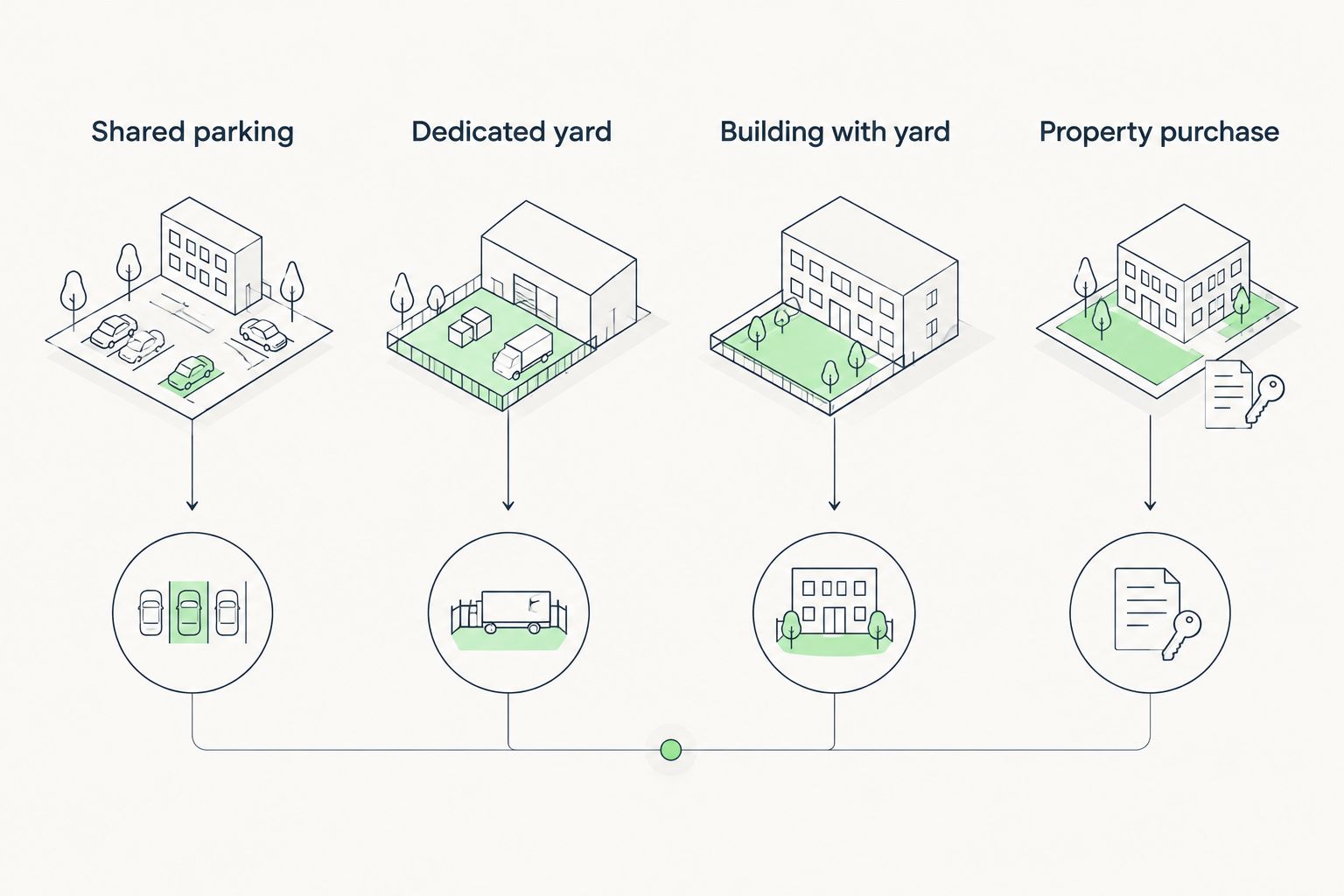
Compare fleet parking and storage options
The best option is the one that matches the permitted operation and the required control. The labels below describe property arrangements, not guarantees about any particular parcel. Verify the documents and layout behind each offer.
| Option | Best for | Main advantage | Key limitation |
|---|---|---|---|
| Shared parking | Fleets needing designated vehicle spaces | Defined parking without taking control of an entire yard | Shared access and operating rules restrict flexibility |
| Dedicated yard | Fleets needing a separate operating footprint | More control over layout and circulation, subject to the lease | Greater responsibility for the occupied property |
| Building with yard | Fleets needing indoor support alongside outdoor space | Combines indoor functions and outdoor operations | Building use and yard use both require verification |
| Property purchase | Operators seeking ownership and long-term control | Ownership rather than a temporary occupancy right | Adds acquisition, financing and ownership obligations |
Start with the fleet's required activities, then compare these arrangements. For a landlord, use the same comparison to decide whether the property suits a shared-parking arrangement or a single occupant; do not promise either configuration before checking its feasibility.
Common mistakes fleet companies and yard owners make
Treating visible truck parking as approval
Trucks on a parcel show an activity, not its legal status. Request the relevant approvals and confirm whether they cover the proposed operation. Owners should distinguish documented permissions from historical practices.
Counting every part of the lot as usable
A fleet cannot park over every square foot it leases. Circulation, access and restricted areas must remain available for their intended purposes. Compare the operating layout with the proposed lease boundaries before accepting a capacity claim.
Leaving maintenance responsibilities vague
Surface damage, gate failures and drainage problems create disputes when the agreement does not allocate responsibility clearly. Describe the condition at handover and have counsel review the maintenance language. Do not substitute an informal conversation for the written agreement.
Marketing flexibility that the documents do not support
Owners should not advertise unrestricted storage, repairs or access without a basis for those claims. Describe verified uses and disclose unresolved questions. Prospects need an accurate starting point, not a promise that depends on later approval.
FAQ
What's the difference between truck parking and industrial outdoor storage?
Truck parking describes space used to park vehicles; industrial outdoor storage describes outdoor storage uses that can include vehicles, trailers, equipment or materials. The applicable land-use classification depends on the jurisdiction and the actual activity.
Can I use any industrial lot for fleet parking in Ontario, California?
No—industrial zoning alone does not establish permission for a particular fleet operation. Confirm the parcel's approvals, conditions and proposed activities with the responsible planning authority.
Is a dedicated truck yard better than shared parking?
A dedicated truck yard is better for a fleet that needs a separate operating footprint, provided the permitted use and lease support that operation. Shared parking fits operators who can work within designated spaces and shared access rules.
How do I work out how many trucks fit in a yard?
Use a site-specific layout showing vehicles, turning movements, access lanes and restricted areas. Gross acreage alone does not establish workable vehicle capacity.
Can a fleet repair trucks in its leased parking yard?
Do not assume parking permission includes truck repairs. Verify both the land-use permission and the lease language before including maintenance activities in the operation.
What should a landlord collect before leasing a truck yard?
A landlord should collect a written operating description and evaluate it against the property's permissions and physical layout. Review the proposed tenant, insurance requirements, maintenance allocation and restoration obligations before signing.
Who can help an Inland Empire owner lease a truck yard?
Javier Brown provides commercial real estate brokerage for truck yards and other commercial properties in the Inland Empire. Brokerage supports the transaction, while legal, land-use and technical questions require the appropriate professional or authority.
One last thing
Before your next 2026 yard tour, ask the fleet dispatcher to mark a typical day's vehicle movements on the proposed site plan. For owners, request that marked-up plan before agreeing to a use description. A parking diagram shows where trucks stop; an operating plan shows whether the yard works.