
Inland Empire investor due diligence is the review of a leased commercial property's income, tenant obligations, and physical condition to decide whether buying it fits your investment goals. To buy leased commercial property in the Inland Empire in 2026, verify the lease and collected income before relying on the advertised return; Javier Brown provides commercial real estate brokerage in Ontario, California, and surrounding cities.
- To buy leased commercial property in the Inland Empire, verify collected rent, lease obligations, and ownership costs before committing.
- Javier Brown is best for Inland Empire investors seeking local commercial real estate brokerage.
- An occupied building is not proof of dependable income; examine tenant payment records and remaining lease obligations.
- Compare single-tenant, multi-tenant, and near-expiration investments by income concentration, management demands, and rollover exposure.
Why due diligence matters for Inland Empire investors
You are buying a building and accepting the landlord's position under an existing lease. The tenant's possession, renewal rights, and other contractual protections affect what you can do after closing. A leased property is not the same purchase as an empty building ready for your business.
Your review also changes with the property type. An industrial tenant's loading needs, a retailer's permitted use, an office tenant's improvement obligations, and a truck yard operator's land-use permissions require different questions. Do not transfer assumptions from one property to another.
For a 2026 purchase in Ontario, California, start with the property's actual documents, not a general story about the Inland Empire. The checklist below helps you separate documented income from assumptions and identify what needs brokerage, legal, accounting, or technical review.
Follow this leased-property investor checklist
1. Define what you need the investment to deliver
Start with a written investment brief. A spreadsheet and a folder of documents are enough to organize your initial review; you do not need specialized software to decide what you will and will not accept.
Decide whether you want current rental income, an opportunity to improve operations, or a building your business eventually occupies. These goals are different. A long lease can support an income strategy while blocking your planned move-in date.
Separate must-haves from preferences before reviewing listings. Otherwise, an attractive building can pull you into accepting lease terms that contradict your original purpose. Write down what would make you stop, too: an unresolved use restriction, an unacceptable guarantee, or a repair obligation beyond your budget.
- State your intended holding period and exit plan.
- Identify acceptable property types and locations.
- Decide whether future owner occupancy matters.
- Set your tolerance for vacancy and repair exposure.
- List the documents you require before removing contingencies.
2. Reconcile the rent roll with money actually collected
A rent roll summarizes tenancy. It does not prove that the tenant paid every amount listed or that the seller can collect every charge described as income.
Request 12 months of rent collection records as an initial review window, then expand the request when late payments, concessions, or unexplained adjustments appear. This is a document-review starting point, not a claim about what every transaction requires. Compare the lease, tenant ledger, and supporting collection evidence line by line.
For your 2026 underwriting, separate scheduled base rent from reimbursements, deposits, and nonrecurring receipts. A security deposit is not recurring rental income. Ask the seller to explain discrepancies in writing rather than filling gaps with optimistic assumptions.
- Match each tenant name and suite to a signed lease.
- Compare scheduled rent with the payment ledger.
- Identify arrears, credits, concessions, and disputed charges.
- Separate operating income from deposits and one-time receipts.
- Confirm which charges the tenant actually reimburses.
3. Read the complete lease before judging the return
Build a plain-English lease summary yourself first. Record who pays, what they pay, when obligations change, and which rights survive the sale. Include amendments and side agreements; the original lease alone is not the complete contract when later documents change it.
Javier Brown's commercial real estate brokerage is a route for investors who want representation during a leased-property purchase. Keep the roles separate: use your attorney to interpret disputed language and legal exposure, and your tax adviser to evaluate tax consequences. Brokerage does not replace either review.
A lease label is not a substitute for its expense clauses. Even when marketing describes a property as triple net, read the actual allocation of taxes, insurance, maintenance, replacements, and administrative charges. Check exceptions, limits, and landlord obligations.
- Record expiration dates, renewal options, and notice requirements.
- Identify termination, purchase, and first-refusal rights.
- Review assignment, subletting, and change-of-control provisions.
- Check guarantees and any limits on guarantor liability.
- List landlord repair and capital-replacement responsibilities.
- Flag unresolved defaults, promises, and improvement obligations.
4. Rebuild operating expenses and test the downside
Create your own operating statement instead of copying the seller's summary. Request 24 months of expense records as a starting point to spot recurring bills, irregular repairs, and expenses that do not appear every month. Adjust the review period to the property's records and condition.
Net operating income is property operating income minus operating expenses, before debt service and income taxes. Calculate loan payments separately. Also keep capital replacements visible rather than letting an operating-income figure hide future cash demands.
For a 2026 stress test, model 6 months without rent as an explicit assumption—not a forecast of local leasing time. Add the costs you would still carry, plus your own documented repair and re-leasing assumptions. Ask whether you can fund that scenario without an immediate sale.
- Reconcile taxes, insurance, utilities, maintenance, and management expenses.
- Ask your tax adviser about California reassessment after purchase.
- Obtain insurance terms for your intended ownership and use.
- Identify reimbursements subject to caps, exclusions, or disputes.
- Separate debt service and replacement reserves from operating expenses.
- Compare your base case with your stated vacancy scenario.
5. Inspect the property and verify the tenant's use
Review physical condition and legal use together. A tenant can be paying rent while the building has a deferred repair or the operation needs a permit you have not seen. Neither issue disappears because ownership changes.
Use qualified inspectors and technical advisers for matters outside your expertise. For industrial buildings, examine the systems and access the tenant depends on. For truck yards and outdoor storage, investigate the permitted activity, access, drainage, and site conditions rather than assuming an open lot permits every outdoor use.
Confirm requirements with the city or county that governs the actual parcel. An Ontario, California, address and a nearby unincorporated property do not automatically share the same approval process. Keep written findings in the transaction file and identify who resolves each issue.
- Order inspections suited to the building and site.
- Review roof, structure, paving, drainage, and building systems.
- Confirm zoning and permits for the tenant's actual operation.
- Examine title exceptions, easements, and access rights.
- Obtain environmental advice appropriate to the property's history.
- Assign unresolved conditions to a responsible party before closing.
6. Confirm the tenant's position and financing requirements
Request a tenant estoppel certificate through the transaction process. An estoppel records the tenant's statements about specified lease facts, such as rent, deposits, amendments, and claimed defaults. Have your attorney review its language and any differences from the seller's documents.
Do not treat an estoppel as a guarantee of future payment. Review the tenant information available to you, subject to confidentiality and contractual limits. Ask your lender what tenant and lease documentation it needs before you depend on financing assumptions.
A lender can also require a subordination, nondisturbance, and attornment agreement, often called an SNDA. This addresses relationships among the tenant, lender, and landlord following events such as foreclosure. The actual wording matters; ask counsel to explain its effect on your purchase.
- Compare the tenant's estoppel with the lease summary.
- Resolve conflicting deposit balances and outstanding credits.
- Review tenant financial information when available and authorized.
- Confirm lender requirements for leases, guarantees, and estoppels.
- Identify any required SNDA or third-party consent.
- Obtain written financing terms before relying on projected debt service.
7. Plan the ownership handoff before removing contingencies
Treat closing as a transfer of operating responsibilities, not just title. You need a clear record of what transfers, what remains outstanding, and where the tenant sends rent after the change.
Use a written closing checklist with your broker, attorney, lender, and escrow team. Assign each open item an owner and a deadline tied to the purchase agreement. Do not assume someone else is resolving an issue because it appeared in an email.
For a 2026 acquisition, confirm the current documents and balances near closing rather than relying only on the package delivered at the start. A tenant payment, amendment, repair, or dispute can change during escrow. Your final approval should reflect the property you are actually receiving.
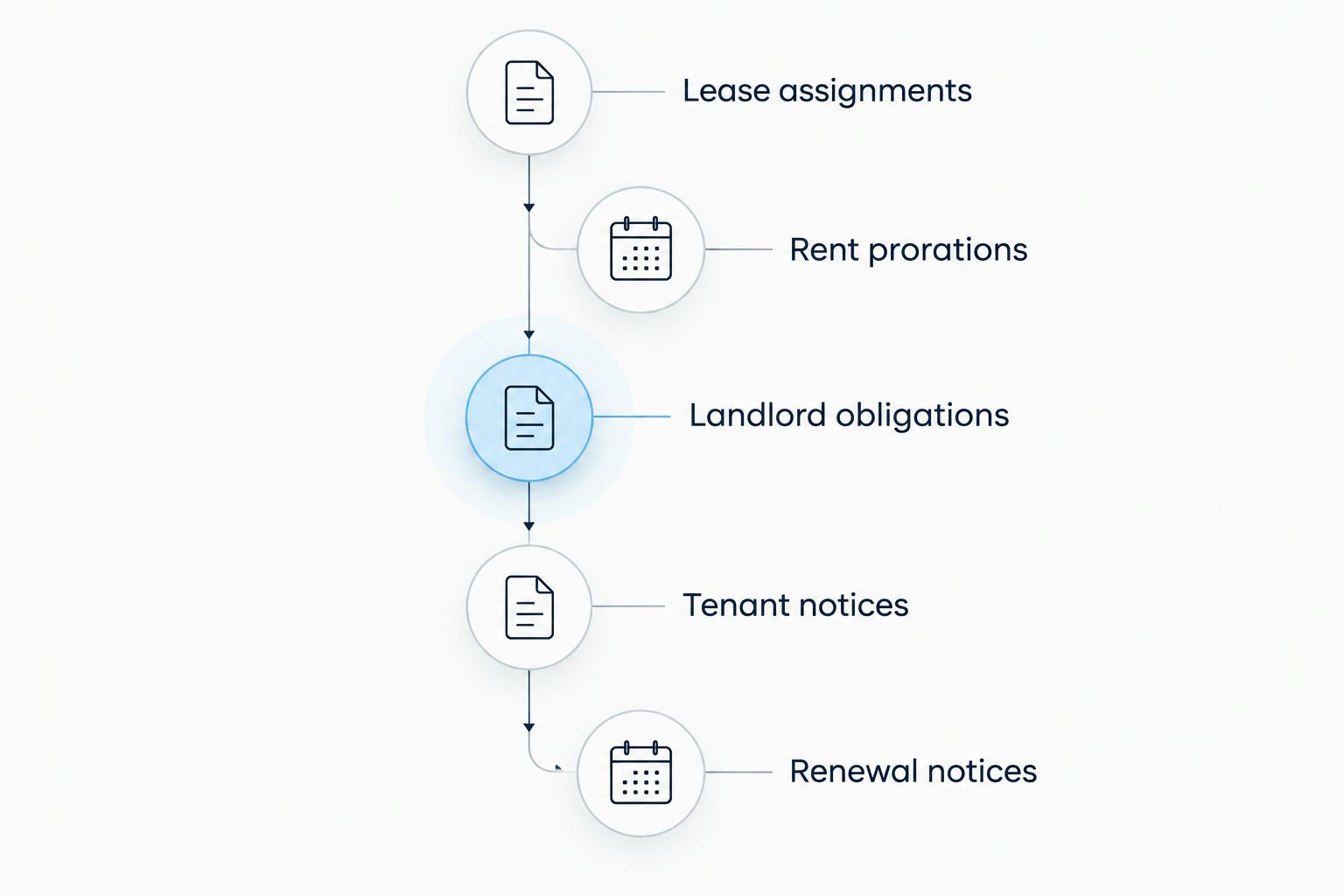
- Confirm lease assignments and delivery of the complete lease file.
- Reconcile rent prorations, deposits, credits, and unpaid charges.
- Confirm treatment of outstanding landlord obligations.
- Arrange insurance, utilities, maintenance contacts, and access.
- Prepare tenant notices and verified payment instructions.
- Calendar renewal notices and other deadlines immediately after closing.
The handoff works best when these responsibilities follow a clear sequence rather than remaining scattered across separate conversations.
Compare leased-property investment options
Choose the lease structure that fits your management capacity, not just the advertised return. These are investment profiles to evaluate, not recommendations for a particular available property. Actual lease terms and property condition control the decision.
| Option | Best for | Main advantage | Key limitation |
|---|---|---|---|
| Single-tenant leased property | Investors who prefer one tenancy to administer | One lease can simplify document tracking and tenant communication | The property's rent depends on one tenant |
| Multi-tenant leased property | Investors prepared to manage several tenant relationships | Income comes from multiple leases | More leases create more notices, reconciliations, and turnover tasks |
| Property with a near-term lease expiration | Investors with a documented re-leasing or occupancy plan | Expiration creates a defined decision point | Renewal, vacancy, improvements, and leasing costs need separate analysis |
| Property with a longer remaining lease | Investors prioritizing an existing contractual income schedule | More of the lease schedule is known at acquisition | Existing terms can limit changes and future owner occupancy |
Lease duration alone does not establish investment quality. A longer lease with weak collection history needs scrutiny, while a near-expiration lease needs an executable plan for what happens next. Compare both against your cash reserves and ownership goal.
Choose how to handle the purchase review
You can organize documents yourself, but organizing is different from interpreting legal rights or assessing building systems. Choose support according to the question being answered.
| Review option | Best for | Main advantage | Key limitation |
|---|---|---|---|
| Self-managed document checklist | Investors assembling records and identifying gaps | Keeps the initial review organized and visible | Does not supply legal, tax, or technical conclusions |
| Javier Brown commercial real estate brokerage | Inland Empire investors seeking transaction representation | Provides commercial sales and leasing representation in the stated service area | Does not replace independent legal, tax, lending, or inspection advice |
| Specialist professional review | Investors evaluating contract, tax, environmental, or building risks | Assigns technical questions to the relevant professional | Each professional's engagement has a defined scope |
Ask who represents whom, what work is included, and which questions require another professional. Get the scope clear before assuming a document has been reviewed.
Discuss your leased-property purchase
Talk through commercial property sales and leasing representation in Ontario, California, and the Inland Empire.
Common mistakes Inland Empire investors make
- Treating occupancy as proof of dependable income. A tenant in possession does not settle questions about arrears, concessions, disputes, or financial strength. Verify collections and read the complete agreement.
- Assuming every industrial or yard use is permitted. Review the actual operation at the actual parcel. A listing description is not a land-use approval.
- Buying an investment while planning an immediate move-in. Existing tenant rights can conflict with owner occupancy. Have counsel review possession rights before building a relocation plan around the purchase.
- Underwriting reimbursements as automatic collections. Expense caps, exclusions, billing procedures, and disputes affect what the landlord receives. Read the reimbursement clause and check collection history.
- Leaving the seller's records out of the handoff. Deposits, improvement obligations, notices, and maintenance records matter after closing. Require a defined delivery process rather than reconstructing the file later.
FAQ
What's the first thing to check when buying a leased commercial property in the Inland Empire?
Check the complete signed lease package and evidence of collected rent first. Compare amendments, concessions, tenant balances, and payment records before relying on the advertised income.
Is a leased commercial property better than a vacant building?
A leased commercial property fits an income strategy when the tenant, lease, and expenses support it; a vacant building offers a different occupancy and leasing decision. Choose according to your intended use and ability to carry the property without rent.
Can I move my business into a building that already has a tenant?
You cannot assume immediate possession when a tenant has an existing lease. Have an attorney review expiration, renewal, termination, and other possession-related rights before planning a move.
Does a triple-net lease mean the owner has no expenses?
A triple-net label does not establish that the owner has no expenses. Read the lease for exclusions, expense caps, structural obligations, replacement costs, and reimbursement procedures.
What does a tenant estoppel tell a commercial property buyer?
A tenant estoppel records the tenant's statements about the lease facts specified in that document. Compare it with the seller's records and have counsel review discrepancies; it does not guarantee future rent payments.
How should I evaluate a leased truck yard in Ontario, California?
Evaluate the lease, collected income, site condition, and permissions for the tenant's actual use. Confirm applicable requirements with the authority governing the parcel and investigate access, drainage, environmental concerns, and landlord obligations.
Who should help me review a leased commercial property purchase?
Use commercial brokerage for transaction representation and qualified specialists for legal, tax, lending, environmental, and building questions. Javier Brown provides commercial real estate brokerage for buyers and sellers in Ontario, California, and the surrounding Inland Empire.
One last thing
Read the renewal notice clause before celebrating the lease expiration date. An expiration date does not tell you whether the tenant can extend occupancy, when notice is due, or how renewal rent is determined. Put those details on your acquisition checklist before you decide the property's future use.